


Table of Contents
Why Many Financially Savvy Individuals Choose to Buy Property With Loans Instead of Full Cash
In Singapore, this question always pops up whenever we talk about buying property:
“If someone already has the money, why don’t they just buy the place fully paid?”
It sounds logical, right? No loan, no stress, no interest.
But if you look closely at how financially savvy buyers and strategic property investors plan their moves, many of them actually choose to take a loan even when they can afford to pay full cash. And they’re not doing it because they have to, they’re doing it because it makes financial sense.
The idea of using leverage, distinguishing between good and bad debt, and evaluating returns based on cash outlay… these concepts might sound “big,” but they’re actually very practical. More and more well-informed buyers are searching for these terms because they want to make smarter, safer decisions in today’s market.
In this article, I’ll break everything down, why experienced investors use property loans, how leverage works, and how the right loan strategy can help improve your cash flow and long-term returns.
Whether you’re thinking of upgrading, buying your first investment property, or just planning ahead, understanding these principles will give you clearer confidence in your next step.
What Is Debt? Understanding the Basics Before You Invest
Before we talk about leverage and property strategies, let’s start with something fundamental, but often misunderstood: Debt.
In simple terms, debt is just money you borrow now and return later, usually with some interest. It can be anything from a housing loan to a car loan to credit card balances. But in the property world, especially in Singapore, most people are referring to a housing loan when they talk about debt.
A mortgage lets you own a property with much less cash upfront, while spreading the repayment over 20 to 30 years. That’s why many financially savvy buyers and experienced investors use it as a planning tool, not just a way to “afford” a home, but a way to manage their cash flow and maximize long-term gains.
A Simple Analogy
Think of debt like using a lever to lift something heavy.
If you try to lift a big rock with your bare hands, it’s tough.
But if you use a long pole as a lever, suddenly you can lift it with much less effort.
A loan works the same way.
It gives you “extra strength” to control a larger asset without putting in all your cash at once.
BUT, just like using a lever wrongly can hurt you, using debt carelessly can create stress.
Debt Isn’t Good or Bad; It Depends on How You Use It
Debt, by itself, is neutral.
What matters is whether it helps you move forward or holds you back.
- When used correctly, debt can help you grow wealth, control bigger assets, and keep cash available for other opportunities.
- When used poorly, it can reduce your cash flow, increase pressure, and limit your choices.
That’s why understanding the difference between productive debt and unproductive debt is so important, especially when deciding between buying a property with full cash or with a bank loan.
Good Debt vs Bad Debt: Understanding the Difference Matters

Not all debt is the same. This is one of the first things financially savvy buyers learn, and it’s a big reason why they feel more confident using loans, while others feel stressed by them. Once you understand the difference between a good debt and a bad debt, your whole view on borrowing starts to change
What Is Good Debt?
Good debt is borrowing that actually helps you build your financial future.
It’s the kind of debt that supports you in owning assets that either:
- grow in value, or
- generate rental income, or
- improve your financial position over time.
Common examples in Singapore include:
- Property loans that help you secure an asset that appreciates
- Business loans that expand your earning ability
- Education loans that increase long-term income potential
Good debt works with you instead of against you.
It lets you control a valuable asset using less upfront cash, and the asset itself helps to offset the loan cost, either through growth or income.
This is why strategic property investors study concepts like leverage, cash-on-cash return, and ROI. They’re using debt as a tool, not a burden.
What Is Bad Debt?
Bad debt is borrowing for things that lose value, don’t generate income, or drain your cash flow every month.
These are expenses that make life feel heavier instead of helping you grow financially.
Common examples include:
- High-interest credit card balances
- Personal loans used for lifestyle or consumption
- Loans for depreciating items like cars, gadgets, or luxury items, unless the item is used to generate income (e.g., PHV/Grab drivers)
Bad debt takes money out of your pocket without giving you anything in return. Over time, it restricts your financial growth and reduces your ability to invest.
Why This Difference Matters for Property Buyers
A well-structured mortgage is considered good debt because:
- The Property appreciates over time,
- It can generate rental income, and
- It helps you grow wealth using a smaller cash outlay.
This is why experienced investors and well-informed buyers focus on loan structure, interest strategy, and leverage potential, not just the purchase price alone.
Once you understand this difference, you’ll start to see that taking a loan is not always a burden.
In many cases, it’s actually a strategic advantage that helps you build wealth more efficiently.
Examples of Debt That Creates Wealth vs Debt That Drains You
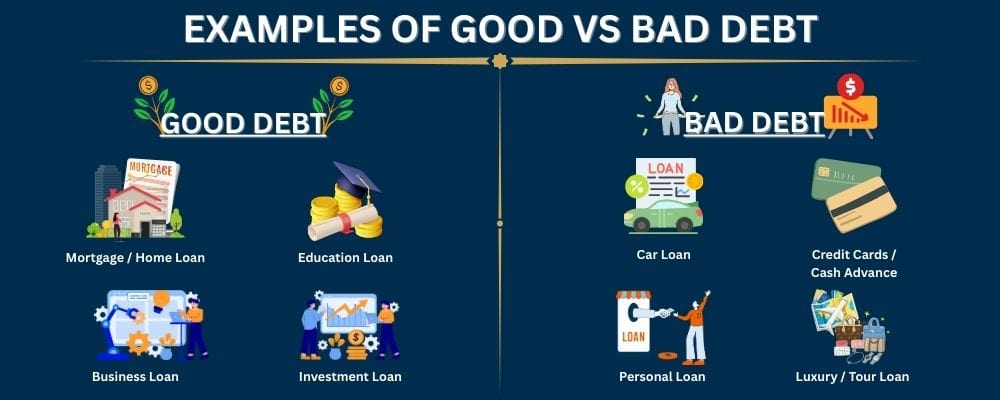
Understanding the debt conceptually is helpful, but seeing how it works in real life is what truly makes the difference. Below are practical examples showing how certain types of borrowing can accelerate wealth, while others quietly drain your financial resources.
1. Debt That Creates Wealth (Good, Productive or Wealth-Building Debt)
a) Using a Property Loan on an Appreciating Asset to Grow Your Wealth
This is the classic one.
Many financially savvy buyers use a mortgage not because they can’t afford the property, but because they understand what the loan helps them achieve.
Why does it work?
- Property values generally appreciate over time
- Rental income for investment property can help offset monthly instalments
- You control a large asset with a relatively small cash outlay
- The asset can be refinanced or sold later for profit
It’s like owning a goose that lays eggs, and the bank is helping you buy the goose.
This combination of capital appreciation, positive cash flow, and leverage is why many experienced investors take a loan even when they have the cash to pay in full.
b) Loans That Support Business or Productivity
Examples include:
- Expanding a business, such as expansion capital for profitable business operations
- Buying equipment that increases production or efficiency to generate higher revenue
- Investing in marketing that brings more customers
Borrowing here creates more income than the interest cost, turning debt into a multiplier.
It’s like planting seeds.
You’re borrowing a little now, but the harvest later is bigger than the cost.
c) Education or Skill-Upgrading Loans
This one is often overlooked, but very real:
- Courses that upgrade your professional skills
- Professional certifications that raise your income ceiling
- Training that leads to higher career opportunities
If borrowing $10,000 today helps you earn an extra $50,000 over the next few years, that’s productive debt.
2. Debt That Drains Wealth (Bad, Unproductive or Wealth-Draining Debt)
a) High-Interest Consumer Debt
These are the debts that quietly eat away at your finances:
- Credit card balances
- Buy-now-pay-later plans
- Personal loans for lifestyle spending
The problem?
The interest compounds against you pile up faster than you can clear them, thus reducing your ability to save or invest.
It’s like running on a treadmill — a lot of effort, but you’re not going anywhere.
b) Borrowing for Depreciating Assets
Not everything we buy holds its value. For example:
- Personal-use cars
- Expensive gadgets
- Luxury items
- Home renovations driven purely by aesthetics (no value uplift)
These things make life more comfortable, but financially… they don’t grow.
Side note: If a car is used to earn income (Grab, PHV, logistics work), that’s a different category, that’s productive.
c) Taking On Loans Without Cash Flow Planning
This is where things can get risky, and leverage becomes harmful when:
- Monthly instalments that are too high, such as exceeding income support
- No emergency buffer is maintained
- Borrowing is based on optimism instead of numbers
- Overestimating future income
It’s like jumping into a swimming pool without checking if you can stand in the water.
This is what well-informed buyers avoid. They don’t borrow based on hope — they borrow based on numbers.
Why This Matters for Property Buyers or Investors
When you recognize the difference between good and bad debt, something changes:
You will stop seeing loans as “burdens,” but you will start seeing them as strategic financial tools, not just a commitment.
Using good debt wisely can help you:
- Keep more cash on hand
- Multiply your return on equity
- Build long-term financial stability
- Grow your property portfolio safely
This sets the foundation for understanding why strategic property investors intentionally use loans instead of paying full cash for property purchases.
Some Thoughts on Why Many Savvy Investors Prefer Using a Bank Loan When Buying Property
One comment I hear all the time is:
“If someone has the money, shouldn’t they just pay full cash for the property?”
On the surface, it sounds logical: no loan, no interest, less stress.
But when you talk to financially savvy buyers, experienced investors, or even people who’ve been through a few market cycles, many of them will tell you the same thing:
“I can pay cash… but I choose not to.”
Why?
Because for them, it’s not about whether they can afford it.
It’s about whether that’s the smartest way to grow and protect their money.
Let me share some of the reasons I’ve observed. And of course, if you have your own thoughts or experiences, do share with me too; I’m always curious to learn what others are seeing on the ground.
1. They Use Leverage to Grow Faster with Less Cash Outlay
Using a loan means you’re controlling a large asset with a smaller upfront amount.
This alone can significantly boost your returns.
Think of it this way:
If someone has $1.5M cash, they can fully pay for one property.
But that same $1.5M could also help them secure two or even three properties (residential or non-residential) when leverage is used responsibly.
It’s the idea of using “other people’s money” (OPM) to multiply their results.
2. They Want to Keep Their Cash Free for Better Opportunities
This is a big one.
Strategic property investors value liquidity because it gives them flexibility.
Instead of locking all their money into one property, they keep cash ready for:
- Business investments
- Undervalued stocks or REITs
- Distressed sales
- New launches
- GLS opportunities
- Family or emergency needs
A mortgage keeps them nimble.
Cash gives options, and options create opportunities.
3. They Understand That Singapore’s Interest Rates Are Often Lower Than Returns
Many well-informed buyers notice this pattern:
Over the long term in Singapore:
- Property grows faster than mortgage interest
- Investment returns tend to beat loan rates
- Inflation makes money lose value over time
So if you can borrow at a lower rate while your asset grows at a higher rate, it becomes a quiet form of interest rate arbitrage.
That’s why some people call it “cheap money.”
4. It Helps Them Maintain Healthier, More Manageable Cash Flow
Paying everything up front is clean, but it also puts pressure on your cash reserves.
By spreading costs over 20–30 years, investors can:
- Keep the monthly cash flow stable, lower financial pressures
- Align repayment with rental income
- Hold the unit comfortably, even during downturns
- Avoid feeling “cash stuck” after a big purchase
This is especially useful for properties intended for rental yield.
5. They Don’t Want All Their Wealth Sitting in One Property
Putting millions into a single fully-paid property can create concentration risk.
Using leverage allows them to diversify:
- Different districts
- Different types of properties
- Different asset classes
- Even in different countries, for some investors
A more balanced spread means one weak market won’t affect the whole portfolio.
Diversification protects wealth, a key principle among affluent investors.
6. Inflation Quietly Works in Favour of Borrowers
This one is rarely discussed but extremely powerful.
When you borrow today:
- The loan amount stays the same
- But property prices rise
- And the value of each dollar drops over time due to inflation
So you’re essentially paying back your loan with “cheaper future dollars,” while your property grows in today’s dollars.
That’s a very favourable equation.
This is another quiet reason financial savvy individuals favour loans.
7. Structured Borrowing Creates Investment Discipline
Some experienced investors actually use loans to stay disciplined.
A mortgage forces:
- Regular financial accumulation through mortgage repayment (like a disciplined savings plan)
- A structured timeline for financial planning
- Better long-term property holding power (less temptation to sell too early)
They treat the mortgage like a forced savings plan or wealth-building habit backed by a growing asset.
8. They Always Think in Terms of Opportunity Cost
This is the biggest mindset difference.
Most people ask:
“Can I afford to pay cash?”
Savvy investors ask:
“Is paying cash the best use of my money?”
If the answer is “no” or “not really,” they choose to leverage, strategically and responsibly, with proper planning.
Case Study: Cash Purchase vs Using a Bank Loan
To really see the power of leverage, sometimes the simplest way is to compare two buyers looking at the same property.
Let’s imagine both of them are buying a $1,000,000 investment unit.
- Same property.
- Same rental market.
- Same growth rate.
The only thing that’s different?
How do they pay for it?
For simplicity, let’s assume:
- Property grows at 3% a year
- Monthly rental income is $3,500
- The average mortgage interest over time is 4%
- Loan tenure 25 years
- LTV 75%
Let’s take a look at how the numbers play out.
Scenario A: Buyer Pays Full Cash
Upfront Cash Outlay
- Purchase price: $1,000,000
- Cash needed: $1,000,000
5-Year Property Growth
Value after 5 years at 3% annual growth: $1,159,274
Capital Gain
$1,159,274 − $1,000,000 = $159,274
Rental Income (Net After Costs)
Assuming net rental of about $2,500/month: 5 years → $150,000
Total Profit After 5 Years
- Capital gain: $159,274
- Rental income: $150,000
= $309,274 total gain
ROI (5-Year Return on Cash Outlay)
$309,274 / $1,000,000 = 30.9% over 5 years
≈ 6.18% annualized
Scenario B: Buyer Uses 75% Bank Loan
Upfront Cash Outlay
- 25% downpayment: $250,000
- Buyer still controls the exact $1M property
- Cash needed: $250,000 (instead of $1M)
5-Year Property Growth
- Value after 5 years:
$1,159,274
(Same as Scenario A, the property value doesn’t care how you financed it)
Capital Gain
Gain still the same: $159,274
Loan Repayment Over 5 Years
Approximate principal repaid in 5 years: $90,000
(This principal repayment is part of your “forced savings.”)
Rental Cash Flow
Assuming rental covers most of the instalment:
Net surplus ~ $500/month → $30,000 over 5 years
Total Wealth Created
- Capital gain: $159,274 (capital appreciation)
- Principal repaid: $90,000
- Rental surplus: $30,000
= $279,274 total gain
ROI (5-Year Return on Cash Outlay)
$279,274 / $250,000 = 111.7% total ROI over 5 years.
≈ 22.3% annualized
Side-by-Side Summary
| Full Cash | With Loan (75% LTV) | |
|---|---|---|
| Cash Outlay | $1,000,000 | $250,000 |
| Total Wealth Gain (5Y) | $309,274 | $279,274 |
| ROI (5Y) | 30.9% | 111.7% |
| Annualised ROI | ~6.18% | ~22.3% |
| Cash Left for Other Investments | $0 | $750,000 |
Key Insight
Here’s the interesting part:
Even though both buyers earned almost the same total profit, the buyer who used a loan earned a much higher return on their cash because they didn’t lock in the entire $1M.
In simple words:
Using leverage helps you grow faster while keeping more cash for other opportunities.
This is one of the core reasons why financially savvy buyers and strategic property investors choose financing over paying full cash, because leverage increases their returns while preserving liquidity.
Risk Management: Some Simple Ways You Can Use Debt Responsibly (Just Like Some Savvy Investors Do)

Leverage can be a powerful financial tool, but only when it’s used with a clear plan.
From what I’ve observed, financially savvy buyers and experienced investors aren’t reckless at all. In fact, many of them are more careful with loans than the average buyer.
They don’t take on debt blindly; instead, they take it on strategically, with buffers, planning, and long-term thinking.
Here are some practical habits you can use to manage debt well and honestly; these are things all of us can apply.
1. Keep a Comfortable Safety Buffer
Before taking on a loan, it helps to set aside a cushion.
Some people like preparing:
- 12 or more months of mortgage instalments
- Extra savings that are easily accessible
- Cash flow projections that include possible vacancies or slower rental months
With a buffer, you don’t feel forced to sell during stressful times. You buy yourself peace of mind.
2. Do a Quick “Stress Test” on Your Numbers
Don’t just calculate based on today’s interest rate.
Most well-informed buyers test their numbers at 4.5% – 5% etc
If the property still feels manageable at the higher rate, then you know you’re in a safe zone.
This protects you against the ups and downs of floating rates.
3. Borrow Within a Comfortable Range (Not Max. Out LTV)
Just because the bank offers you the maximum loan doesn’t mean you must take it.
Some simple ways to stay comfortable:
- Take a slightly smaller loan for better cash flow
- Avoid stretching your finances
- Keep some reserves for opportunities or emergencies
The goal is stability, not stress.
4. Choose Properties That Don’t Strain Your Cash Flow
Before committing, it’s helpful to run simple numbers:
- Can rental cover most of the instalments?
- Can you still hold the unit comfortably if it’s vacant for a few months?
- If for your own occupancy, how much will you really pay out-of-pocket each month after using your CPF OA savings?
A property should support your finances, not drain them.
5. Spread Out Your Risk Instead of Putting Everything into One Basket

Diversification is one habit that strategic property investors swear by.
Simple ideas include:
- Not putting all capital into one big property
- Considering units in different districts
- Having a mix of residential and non-residential or other asset classes
- Keeping part of your wealth liquid
If one area slows down, the rest of your portfolio keeps you steady.
6. Seek Professional Input Before Big Decisions
You don’t need to figure everything out alone.
Many people use:
- Financial projections
- ROI simulations
- Loan comparisons
- Portfolio advice
Speaking to someone who looks at numbers, whether a banker, advisor, or agent, helps you avoid blind spots.
7. Have a Clear Exit Plan Before Buying
Before you commit to a loan, it’s helpful to think about:
- How long do you plan to hold
- Your target returns
- When to refinance
- Whether it’s for rental, future upgrade, or legacy planning
- Under what conditions would you sell
When you have a plan, your decisions feel grounded rather than emotional.
8. Review Your Loan Regularly
Your financing shouldn’t stay the same forever.
Some practical habits:
- Refinance if rates drop
- Switch to fixed rates if you want stability
- Pre-pay a small portion if you have excess funds
- Consider cash-out refinancing if your property value rises and you have a good use for the funds
These minor adjustments can save you money and increase returns over the long term.
The Big Picture
Using a loan responsibly isn’t about taking big risks.
It’s about taking calculated steps, keeping yourself protected, and making decisions based on numbers, not emotions.
With the right habits, debt becomes a tool, not a burden.
And when paired with a solid plan, leverage can be one of the most powerful ways to grow safely and steadily.
Common Misconceptions About Using Loans

A lot of what we believe about loans comes from what we heard when we were younger, from our parents, grandparents, or even friends. And honestly, some of those ideas made sense back then.
But today’s financial world is very different, and many of those old beliefs don’t quite apply anymore.
Here are some common misconceptions I still hear from buyers, along with the simple truths behind them.
Misconception 1: “If you take a loan, it means you cannot afford the property.”
This is probably the most common one.
Reality (in simple words):
Plenty of financially savvy buyers purposely take a loan even when they can pay in full cash.
They do it to:
- keep their cash free,
- grow their money elsewhere,
- diversify their portfolio,
- maintain a safety buffer.
It’s not about “cannot afford.”
It’s about not locking up all their cash in one place.
Misconception 2: “It’s always better to be debt-free.”
Being debt-free feels shiok! I agree. But “feels good” doesn’t always mean “grows wealth.”
Reality:
Not all debt is bad.
Good debt helps you buy assets that appreciate and put money back into your pocket.
That’s why well-informed buyers prefer leverage rather than dumping every cent into a fully paid property.
Misconception 3: “Interest is wasted money.”
This belief causes some buyers to rush and pay full cash without thinking long-term.
Reality:
Yes, you’re paying interest…
But in return, you also get:
- capital appreciation on the entire property value,
- higher cash-on-cash returns,
- rental income supporting the loan,
- liquidity to invest elsewhere.
So interest is not just a “cost.”
It’s the price of using leverage, and often, the returns outweigh it.
Misconception 4: “Leverage is risky.”
Leverage can be risky… when misused.
Reality:
With the proper planning:
- Buffer set aside,
- stress test for not over-leveraging,
- proper cash flow planning,
- conservative borrowing by not maximizing
Leverage becomes a controlled and calculated tool.
This is why banks, developers, REITs, and big institutions all use debt daily.
They don’t fear leverage; they manage it.
Misconception 5: “It’s smarter to clear the mortgage as fast as possible.”
This sounds very safe and responsible… but it may not always be the best financial move.
Reality:
Experienced investors always compare:
“Can this money grow more somewhere else?”
If their cash can earn:
- higher returns,
- better liquidity,
- or more diversification…
Then it makes more sense to invest it rather than rush to clear the loan.
Misconception 6: “Taking a loan means more stress.”
Many people feel this way because of bad experiences with credit card debt or past financial struggles.
Reality:
A well-planned housing loan is actually very stable and predictable.
With proper structure:
- instalments are manageable,
- Interest is controlled,
- rental income helps,
- The holding power is strong.
Loans only become stressful when they’re unmanaged, not because loans are “bad.”
Misconception 7: “Full cash buyers get better deals.”
Many buyers assume sellers will offer a discounted price if they pay in full cash.
Reality:
In Singapore, especially for new launches, prices are fixed.
Whether you pay cash or use a loan, the price doesn’t change.
What matters more is timing and decisiveness, not how you pay.
Plus, full-cash buyers lose something important:
The opportunity cost is the income or returns they could’ve earned if their cash had stayed invested elsewhere.
Why Clearing These Misconceptions Matters
Once you let go of outdated beliefs, you can make decisions based on:
- real numbers,
- today’s financial environment,
- modern strategies,
- and long-term wealth planning.
This mindset shift helps you build resilience, confidence, and a much healthier approach to using leverage.
Summary
At the end of the day, property loans aren’t just for people “who can’t afford” a home. In fact, many financially savvy buyers and strategic property investors use loans even when they have the full cash ready. It’s not about ability, it’s about understanding how money works in the long run.
When you know the difference between a good debt and a bad debt, you start to see that a well-planned mortgage can actually be a great financial tool — one that helps you grow your wealth steadily while keeping your cash flexible.
Leverage, when used responsibly, allows you to:
- Take control of a large appreciating asset with much less upfront cash
- Increase your return (ROI) through better cash-on-cash performance
- Maintain cash reserves for other opportunities
- Benefit from inflation, future income growth, and long-term property price growth
- Strengthened your holding power by managing your risk using buffers, stress tests, and diversification
And here’s the critical part:
It’s responsible borrowing that makes the difference, not borrowing blindly. Well-informed buyers focus on stability, long-term planning, and realistic numbers. They don’t overstretch; they build steadily.
When approached with the right mindset, proper calculations, and a clear game plan, a property loan becomes more than just financing. It becomes a strategy, a practical and powerful one, that can support long-term financial security, smarter portfolio growth, and a more sustainable wealth journey.
If you’re exploring your own property plans, understanding leverage is one of the best ways to make confident, well-informed decisions for your future.
If you’re planning your next move, whether upgrading, investing, or restructuring your portfolio or simply planning ahead, understanding how to use leverage wisely can make a meaningful difference in the way you build wealth over time.
Everyone’s situation is unique, and the right financing strategy depends on your goals, holding power, cash flow, and timeline. They all play a part in deciding whether a loan is the right move and how much leverage makes sense.
If you’d like a clearer, personalized view of what leverage can do for you, I’m happy to walk you through it, and we can explore things like:
- A customized financial breakdown you can easily understand
- ROI comparison and projections with and without leverage
- Cash flow planning and interest rate stress-testing
- A step-by-step property strategy aligned to your goals
If you want to explore how to maximize your results safely and confidently, feel free to reach out. I’m always happy to guide you through the numbers and options.
Need Real Estate Consultation?
Contact Me
Feel free to connect with me!

Group District Director
Huttons Asia Pte Ltd
CEA Registration No.: R026434F
Agency License: L3008899K
Contact: 93839588

P1 Registration 2027: Which Condos Gain From the New 2km Rule?
MOE’s 2027 P1 registration changes remove the within-1km Phase 2C advantage at 12 popular schools. Which condos gain from the new 2km rule, and how should buyers and sellers rethink the 1km school premium?

What are Prime Location Public Housing (PLH), Plus and Standard Model and Its Effect
Prime Location Public Housing (PLH), Plus and Standard HDB model on future new BTO located in City centre and Greater Southern Waterfront. Understand more here.
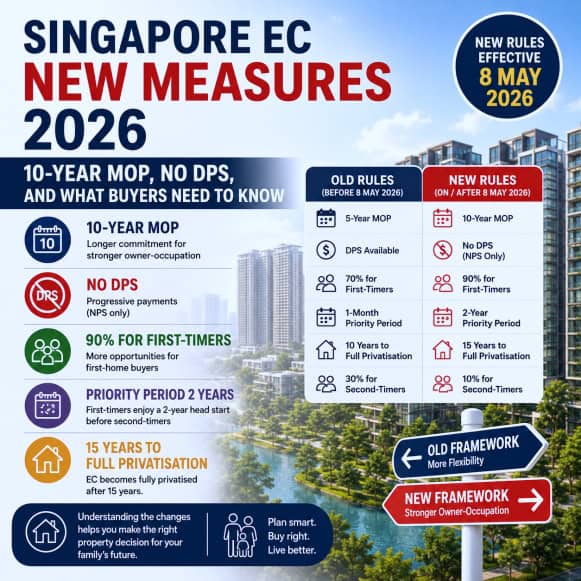
Singapore EC New Measures 2026: What Every Buyer Needs to Know Before Making Their Next Move
Singapore’s EC rules changed on 8 May 2026 — 10-year MOP, no Deferred Payment Scheme, a higher first-timer quota, and a long first-timer priority period. Here’s what it really means for your next property move.

Where Can You Find and How to Buy an Upcoming Executive Condominium (EC) in 2026
Updated with New EC Rules 2026
. Buying Exec Condo EC Guides 2026. Rivelle at Tampines EC, Coastal Cabana EC at Pasir Ris. Other Upcoming New Launch EC include Senja Close, Woodlands Dr 17 and Sembwang Road site. Purchase Procedures Guides Available. Connect for more info now.

9 Tips to Choose a Good Unit in a Resale Condominium in Singapore
Choosing a resale condo in Singapore? Here are 9 tips on liquidity, layout, facing, lease decay, schools, future growth, and value for money to guide you.

12 Tips to Choose a Good Unit in a New Launch Condominium Project
12 practical tips for choosing a good unit in a new launch condo in Singapore — facing, floor level, layout efficiency, and price benchmarking explained.


