

Table of Contents
15-Month HDB Wait-Out Period Removed With Immediate Effect
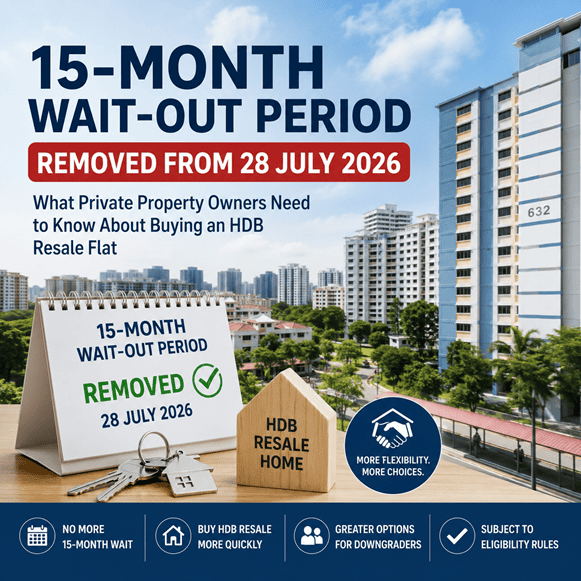
On 28 July 2026, the Singapore Government removed the 15-month wait-out period that applied to private residential property owners and former owners buying a non-subsidised HDB resale flat, with immediate effect.
Private property owners and former owners of all ages, buying any non-subsidised HDB resale flat type, no longer need to wait 15 months after selling their private property before they can buy one. The change matters most for households moving from a condominium or landed home into an HDB flat, who previously often had to sell their private property first, arrange temporary accommodation, and wait more than a year before they could complete the move.
That does not mean every restriction on private owners buying HDB flats has disappeared. Several other rules, including a separate and longer wait-out period for subsidised housing, remain firmly in place. To understand what has actually changed, and what has not, it helps to look at why the 15-month rule existed in the first place, why the Government decided it was no longer needed, and what the removal means in practice for buyers and sellers.
Quick facts
- Removed with immediate effect from 28 July 2026
- Applies to non-subsidised HDB resale flats only, of any flat type, for buyers of any age
- The 30-month wait-out period for subsidised housing, CPF housing grants, new Executive Condominiums, and HDB housing loans is unchanged
- Existing private property owners must still dispose of all private residential property, in Singapore and overseas, within 6 months of completing the HDB purchase
What was the 15-month wait-out period?
The 15-month wait-out period was a temporary housing measure introduced on 30 September 2022. It required private residential property owners, and former private residential property owners, to wait 15 months after disposing of their private property before they could purchase a non-subsidised HDB resale flat.
The rule covered two groups: existing private homeowners who were planning to sell and move into an HDB flat, and former private homeowners who had already sold their property but had not yet completed the required waiting period.
Before 30 September 2022, eligible private property owners could generally buy a non-subsidised HDB resale flat without serving any additional wait, and were instead required to dispose of their private residential property within six months of completing the HDB purchase. The introduction of the 15-month rule changed that sequence significantly, requiring owners to sell first, sit out the wait, and only then buy.
The 15-month rule applied specifically to non-subsidised HDB resale flats bought on the open market. It never replaced, and was never the same as, the separate and considerably longer 30-month wait-out period that continues to apply when a private property owner or former owner buys subsidised housing, including a new flat from HDB, a resale flat bought with CPF housing grants, a new Executive Condominium from a developer, or an HDB resale flat financed with an HDB housing loan.
There was one exemption while the rule was in force. Singapore citizens aged 55 and above were exempted from the 15-month wait, but only for a four-room or smaller non-subsidised HDB resale flat — the exemption did not extend to larger flat types. This supported older homeowners who wanted to right-size, reduce their housing commitments, or unlock part of their housing wealth for retirement. Seniors buying a larger flat, such as a five-room flat, Executive Apartment, or Executive Maisonette, fell outside the exemption and still had to serve the full 15-month wait, the same as everyone else.
Households facing genuine hardship, such as financial difficulty, medical issues, or divorce, could appeal to HDB for assistance, and these were assessed case by case. HDB processed roughly 1,800 such appeals a year, with about one in four approved — a meaningful number of households with genuine, time-sensitive housing needs each year.
Why was it introduced in 2022?
Housing supply had been disrupted by the pandemic. Construction delays meant some buyers waited longer for their Build-To-Order flats and turned to the resale market instead, since resale flats were already completed. Housing preferences were shifting too, with more households wanting their own space or an extra room. All of this pushed demand toward an already limited pool of resale flats.
Resale prices were climbing quickly: the HDB Resale Price Index rose 12.7% in 2021 and a further 10.4% in 2022, broad-based growth that risked affecting affordability across more towns and flat types, particularly for first-time buyers.
Private property owners added another layer of demand. Before the 15-month rule, an eligible owner could sell a condominium or landed property, buy a non-subsidised HDB resale flat, and dispose of the private property within six months. Some were downsizing for genuine reasons, but others entered the market with substantial sale proceeds that could put them in a stronger position when competing for larger or highly sought-after flats.
The 15-month rule was part of a wider cooling package. From 30 September 2022, the maximum HDB housing loan LTV was cut from 85% to 80%, with a 3% interest-rate floor introduced, and tightened again to 75% in August 2024. Demand-side measures like these take effect quickly; increasing the physical supply of flats takes years. The wait-out period was designed to buy time while supply caught up, and was always described as temporary.
Why was it removed in 2026?
By July 2026, the Government assessed that the rule had done what it set out to do. The Resale Price Index fell 0.1% in Q1 2026 and a further 0.3% in Q2 2026, following five consecutive quarters of slower or flat growth stretching back to Q4 2024.
Supply was also improving: a growing number of flats are reaching their Minimum Occupation Period, and HDB is planning around 19,600 BTO flats for 2026, including over 4,000 with shorter waiting times.
There is direct evidence the rule achieved its purpose. Private property owners and former owners accounted for around 34% of buyers of million-dollar HDB flats between January and September 2022; by January to November 2024, that share had fallen to roughly 12%. Set against that, the roughly 1,800 appeals processed each year kept surfacing the human cost of the rule, mainly households facing financial difficulty or a genuine lack of alternative housing.
Taken together, the decision reads less like a reversal and more like a calibrated adjustment: introduced when demand outpaced supply, removed once prices moderated, supply improved, and the ongoing cost to genuine downgraders was judged to outweigh the benefit of keeping it in place.
What changed: before vs after
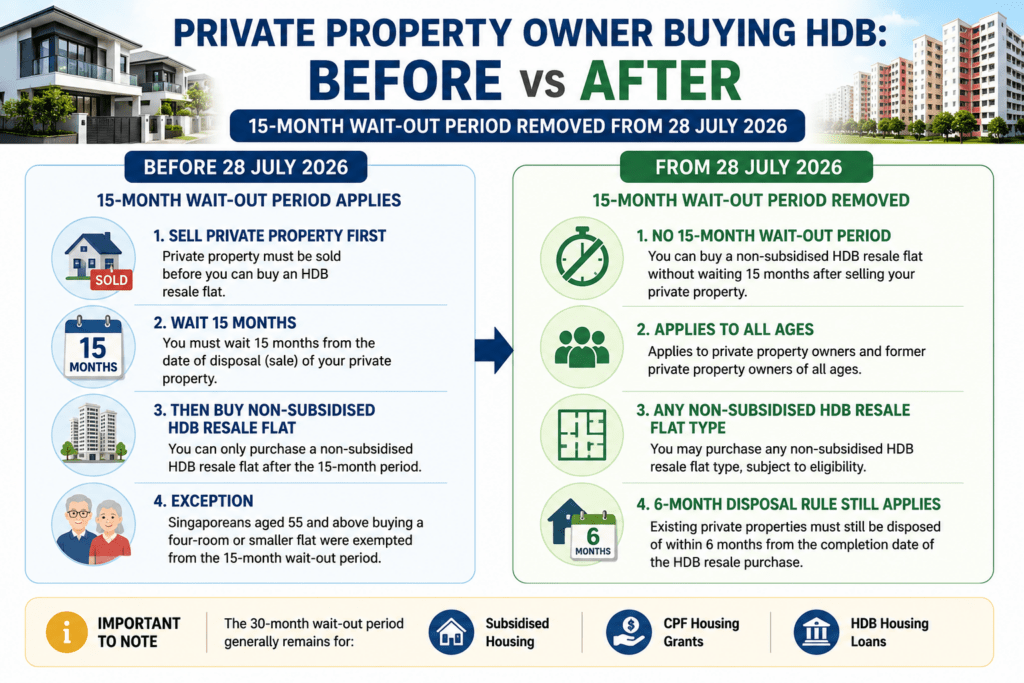
Before-and-after comparison of the HDB rules for private property owners following the removal of the 15-month wait-out period from 28 July 2026.
Before 28 July 2026 — 15-month wait-out period applied
- Sell private property first — private property had to be sold before an HDB resale flat could be bought.
- Wait 15 months — counted from the date of disposal of the private property.
- Then buy a non-subsidised HDB resale flat — only allowed after the 15-month period ended.
- Exception — Singapore citizens aged 55 and above buying a four-room or smaller flat were exempted from the wait, but could not buy a larger flat type without waiting.
From 28 July 2026 — 15-month wait-out period removed
- No 15-month wait-out period — a non-subsidised HDB resale flat can be bought without waiting after selling private property.
- Applies to all ages — private property owners and former owners of any age.
- Any non-subsidised HDB resale flat type — including flats larger than four rooms, subject to eligibility. This also removes the size cap that used to apply even to the exempted 55+ group.
- 6-month disposal rule still applies — existing private property must still be disposed of within six months of completing the HDB resale purchase.
Important to note: the 30-month wait-out period generally remains for subsidised housing, CPF housing grants, new Executive Condominiums, and HDB housing loans.
In practice, this means an eligible owner can now buy their HDB resale flat before selling their existing private property, rather than being forced to sell first and wait over a year in between. Two things this removal does not touch, and which are worth restating clearly:
The 30-month wait-out period for subsidised housing. This still applies to a new flat bought directly from HDB, an HDB resale flat bought with CPF housing grants, a new Executive Condominium bought directly from a developer, or an HDB resale flat financed with an HDB housing loan.
Standard HDB eligibility rules. Citizenship, family nucleus, ownership interests, and the Ethnic Integration Policy or Singapore Permanent Resident quota, where applicable, all still apply. Buyers also still need a valid HDB Flat Eligibility (HFE) letter before a seller can grant them an Option to Purchase.
Who benefits most from the removal
- Retirees and homeowners planning to right-size stand to benefit most directly. Previously, anyone below 55, or buying a flat larger than four rooms, had to serve the full 15-month wait regardless of how straightforward their move was.
- Households facing financial or family changes, including financial pressure, divorce or separation, medical or mobility needs, or a need to live closer to family support, are often the households for whom the old wait-out period was most disruptive.
- Buyers who need larger flats gain flexibility that did not exist before for anyone. Previously, even the exempted 55-and-above group was capped at four-room or smaller — they could skip the wait, but only for a smaller flat. Now that same group, along with everyone else, can buy a five-room flat, an Executive Apartment, or an Executive Maisonette without waiting at all.
- Sellers of certain HDB flat types may also see some benefit, since the removal widens the pool of eligible buyers for larger or rarer units, though the effect will still depend on a flat’s location, lease, condition, and asking price.
A worked example
Say a couple in their late 40s owns a condominium and wants to move into a five-room HDB resale flat closer to their parents.
Under the old rule, they would have needed to sell the condominium first, then wait a full 15 months from the date of that sale before they could even submit an offer, since they did not qualify for the 55-and-above exemption and a five-room flat was not covered by it in any case. In the interim, they would most likely have needed to rent, adding a year or more of rental costs and a temporary move.
Under the current rule, the same couple can secure their HFE letter, shortlist HDB flats, and commit to a purchase without waiting at all. They would then have six months from completing that HDB purchase to sell the condominium and settle their CPF refund, loan repayment, and any other obligations tied to it.
This is a stylised example rather than financial advice, since every household’s CPF position, loan eligibility, and timeline will differ, but it illustrates why the change mainly helps genuine downgraders coordinate their move more smoothly.
Market impact: what to expect and what to watch
The removal is likely to bring back a segment of demand rather than reshape the entire market, and where that demand shows up matters more than whether it shows up at all.
The flat types most likely to feel it are five-room flats, Executive Apartments, Executive Maisonettes, recently-MOP flats, and units in mature or well-connected estates — places where supply is already comparatively tight.
Several factors work in the opposite direction. A growing number of flats are reaching their Minimum Occupation Period, and HDB’s planned supply of roughly 19,600 BTO flats for 2026 adds further capacity. The 75% HDB loan LTV cap, CPF usage rules, and the Mortgage Servicing Ratio all still constrain buying power. The six-month disposal deadline still forces private owners to sell within a fixed window. And because private owners still need time to sell, obtain an HFE letter, and find a suitable flat, any market effect is likely to build up gradually over several quarters.
Worth tracking over the next few quarters: transaction volumes and prices for the flat types above, by town; how many former private property owners are actually entering the market; the pace of million-dollar HDB transactions, keeping in mind these often involve rare units or prime locations; and any further policy updates from HDB or MND.
Could the 15-month rule come back?
The Government has not indicated that the rule will return, and it would be wrong to present its reinstatement as a likely or confirmed outcome. But Singapore’s property measures are reviewed and adjusted fairly regularly: the HDB loan LTV limit was cut from 80% to 75% in August 2024, and the four-year Seller’s Stamp Duty holding period, along with higher rates, was reinstated in July 2025 to discourage short-term speculative activity.
If HDB resale demand strengthens meaningfully again, the same exact rule would not necessarily be the Government’s first response. What would likely trigger a fresh review is a sustained combination of rapidly rising prices, strong transaction volumes, growing competition for scarce flat types, a sharp jump in demand from private downgraders, or worsening affordability for first-time buyers, rather than one or two stronger quarters in isolation.
Conclusion
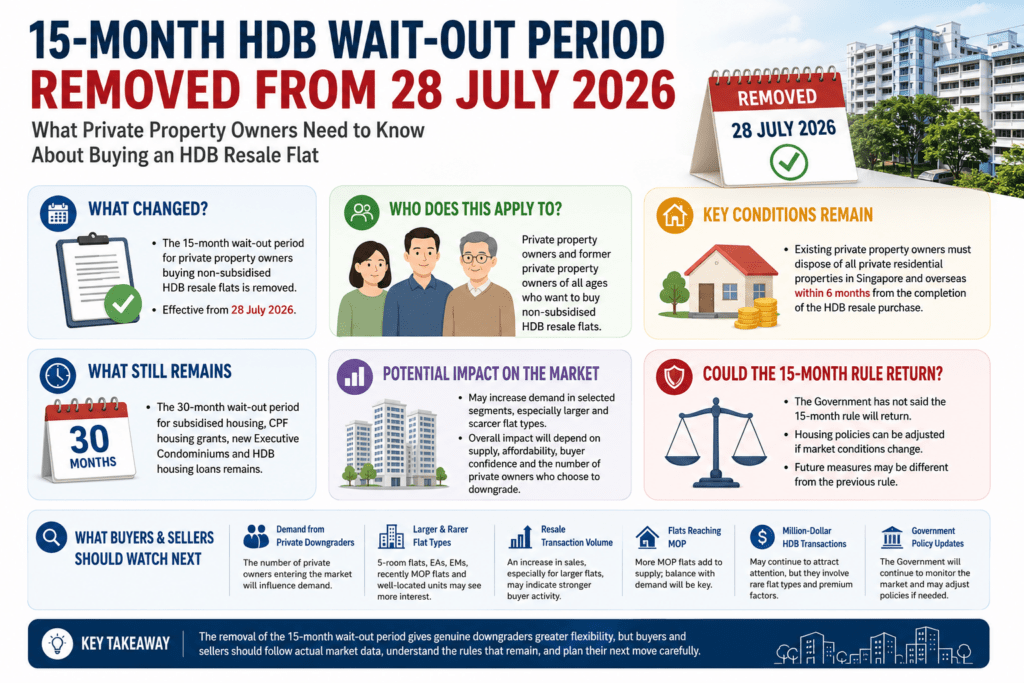
Key points private property owners should know following the removal of the 15-month HDB wait-out period.
For genuine downgraders, this is a meaningful quality-of-life change. It removes the need to rent temporarily or move more than once while waiting out 15 months. For the resale market more broadly, the likely effect is gradual and uneven rather than a broad price shock, concentrated in larger and rarer flat types where supply was already tighter. The 30-month rule for subsidised housing, the loan and CPF limits, and the six-month disposal deadline are all still doing real moderating work behind the scenes, even with the 15-month rule gone.
If you are planning a move from private property into an HDB resale flat, the policy change makes the logistics considerably easier, but the underlying numbers — your CPF refund, loan eligibility, and the timing of both transactions — still need the same careful planning as before.
Frequently asked questions
Yes. From 28 July 2026, private property owners and former owners no longer need to wait 15 months before buying a non-subsidised HDB resale flat, subject to the usual HDB eligibility requirements.
Not necessarily. You can buy the non-subsidised HDB resale flat first, but you must dispose of all private residential property, in Singapore and overseas, within six months of completing the HDB purchase.
Yes. The removal only applies to non-subsidised HDB resale flats. The 30-month wait-out period still applies to subsidised housing, CPF housing grants, new Executive Condominiums, and HDB housing loans.
Yes, to any non-subsidised HDB resale flat type, regardless of size, subject to meeting all other eligibility requirements. The old exemption limited to those aged 55 and above buying four-room or smaller flats is no longer needed.
No. It is actually a bigger change for the 55-and-above group specifically than it might first appear — previously they could skip the wait only for a four-room or smaller flat; now that size cap is gone for them too, alongside the age restriction being gone for everyone else.
You may be in breach of HDB’s ownership conditions. If you anticipate difficulty meeting the deadline, approach HDB as early as possible rather than assume an extension will be granted.
Yes. Buyers must still obtain a valid HDB Flat Eligibility letter before the seller can grant them an Option to Purchase. It confirms eligibility to buy and, where applicable, grant and loan eligibility.
It may increase demand in selected segments, particularly larger or rarer flat types, but a broad price increase is not guaranteed. The outcome will also depend on resale supply, BTO availability, financing conditions, and how many private owners actually enter the market.
Key Takeaways
- The 15-month HDB wait-out period was introduced on 30 September 2022 as a temporary measure to moderate resale demand.
- It was removed with immediate effect from 28 July 2026.
- Private property owners and former owners may now purchase a non-subsidised HDB resale flat without waiting 15 months.
- The change applies to buyers of all ages and to all HDB resale flat types.
- Existing private property owners must still dispose of all private residential properties in Singapore and overseas within six months from the completion of the HDB resale purchase.
- The separate 30-month wait-out period generally remains for subsidised housing, CPF housing grants, new Executive Condominiums and HDB housing loans.
- The removal gives genuine downgraders greater flexibility, but it may also bring additional demand into selected resale segments.
- The market impact is likely to vary according to flat type, location, supply and buyer affordability.
- The Government has not said that the 15-month rule will return, but future housing measures may still be adjusted if market conditions change.
Planning to Move From Private Property to an HDB Resale Flat?
The removal of the 15-month wait-out period may give you more flexibility, but the transaction still requires careful planning.
Before deciding, it is important to understand:
- whether you qualify to buy the HDB resale flat;
- whether the purchase is considered subsidised or non-subsidised;
- the timeline for selling your existing private property;
- your CPF refund and available funds;
- your loan eligibility and monthly commitment; and
- how to coordinate both transactions without creating unnecessary cash-flow or housing gaps.
Every household’s situation is different, especially when retirement planning, financial commitments or family needs are involved.
If you are considering selling your private property and moving into an HDB resale flat, let’s talk through the numbers, timeline and available options first, then decide whether the move makes sense for you.
Need Real Estate Consultation?
Contact Me
Feel free to connect with me!

Group District Director
Huttons Asia Pte Ltd
CEA Registration No.: R026434F
Agency License: L3008899K
Contact: 93839588


