


Table of Contents
Thinking of Becoming a Property Agent? Here's What the New RES Framework Means For You
Thinking about becoming a property agent in Singapore?
Before you sign up for the RES course or pick an agency, take a few minutes to understand the new registration framework kicking in from 1 January 2027. It’ll shape how your career runs from day one.
I don’t think these changes are meant to scare anyone off. But they do make one thing pretty clear: getting your RES registration isn’t a “pass the exam, tuck the certificate away” kind of deal anymore. You’ll need to stay active, stay sharp, and be ready to keep your registration in good standing over time.
RES Registration Moves to a 3-Year Cycle
From 1 January 2027, your registration period stretches from one year to three.
If you’re already registered, your first three-year cycle runs from 1 January 2027 to 31 December 2029. New agents joining from 2027 onward will also have their registration expire on 31 December of their third calendar year, so if you register on 1 April 2027, your registration ends 31 December 2029.
Here’s the part worth flagging though: a longer cycle doesn’t mean you only pay once every three years. Over a full cycle, here’s what you’re looking at:
- Annual registration fee: S$280 a year
- Application fee: S$60, payable once every three years
- Total CEA fees over 3 years: S$900
And that’s before your agency cut, training, marketing, or any other running costs.
So yes, less paperwork each year. But your yearly costs and obligations haven’t gone anywhere.
What Does "Currency Requirement" Actually Mean?
First things first, “Currency” here has nothing to do with money or how much commission you’re pulling in.
It just means staying current. Staying sharp on how the industry actually works.
Property rules change. Transaction procedures change. Documentation and compliance requirements shift over time. This requirement exists so that agents who stay registered, and keep advising real people making real decisions, are actually keeping up with how things are done today, not how they were done five years ago.
From 1 January 2027, you’ll generally need to satisfy the Currency Requirement in one of two ways:
- Complete at least three qualifying property transactions within your three-year registration period, or
- Pass the Refresher Examination
The point isn’t to measure how good a salesperson you are. It’s to make sure the person a client is trusting with the biggest purchase of their life hasn’t fallen out of touch.
New Agents Get Some Room to Find Their Footing
CEA gets it. New agents need time to learn the ropes, meet people, and build a client base from scratch.
So if you’re newly registered:
- Year 1: No transaction required
- Years 2 to 3: At least two transactions required, or pass the Refresher Exam before renewal
That’s a fair bit of breathing room. But don’t mistake it for three years to casually figure out if you even want to do this.
Your first year is prime time to build your foundation, things like:
- Learning how to prospect properly
- Running viewings with confidence
- Explaining regulations clearly to clients
- Handling your paperwork right
- Staying compliant
- Actually walking someone through a full transaction
Use it well.
What Happens If You Don't Hit the Transaction Requirement?
If you don’t meet the transaction requirement, you’ll be eligible to sit for the Refresher Examination instead.
The exam checks whether you’ve still got the practical knowledge to do this job properly. If you miss the transaction requirement and don’t pass the refresher route either, you may not be able to renew for the next cycle.
Again, this isn’t really about sales numbers. It’s about making sure agents advising the public haven’t drifted away from how things are actually done today.
Your Annual Training and MediSave Obligations Don't Disappear
Here’s something worth underlining: a three-year registration doesn’t mean you only need to think about compliance once every three years. Your annual obligations still apply, every single year.
CPD (Continuing Professional Development): Under the framework that kicked in from 1 January 2026, existing RES agents generally need 16 training hours a year, broken down as:
- 4 hours of Prescribed Essentials
- 8 hours of Professional Competencies
- 4 hours of Self-Directed Learning
New agents get a pass on this in their first CPD cycle, but it kicks in from the second cycle onward.
CPF MediSave: You’ll also need to stay current on your MediSave contributions under the Self-Employed Scheme, either paid in full, or covered by an active GIRO arrangement with CPF Board where applicable.
These aren’t one-off boxes to tick. They’re ongoing conditions for keeping your registration alive. Miss your CPD or MediSave obligations, and your registration can lapse, even mid-cycle.
Bottom line: the three-year cycle gives you a longer runway, but training, MediSave, and your annual fee still need managing every single year.
The New Framework At a Glance
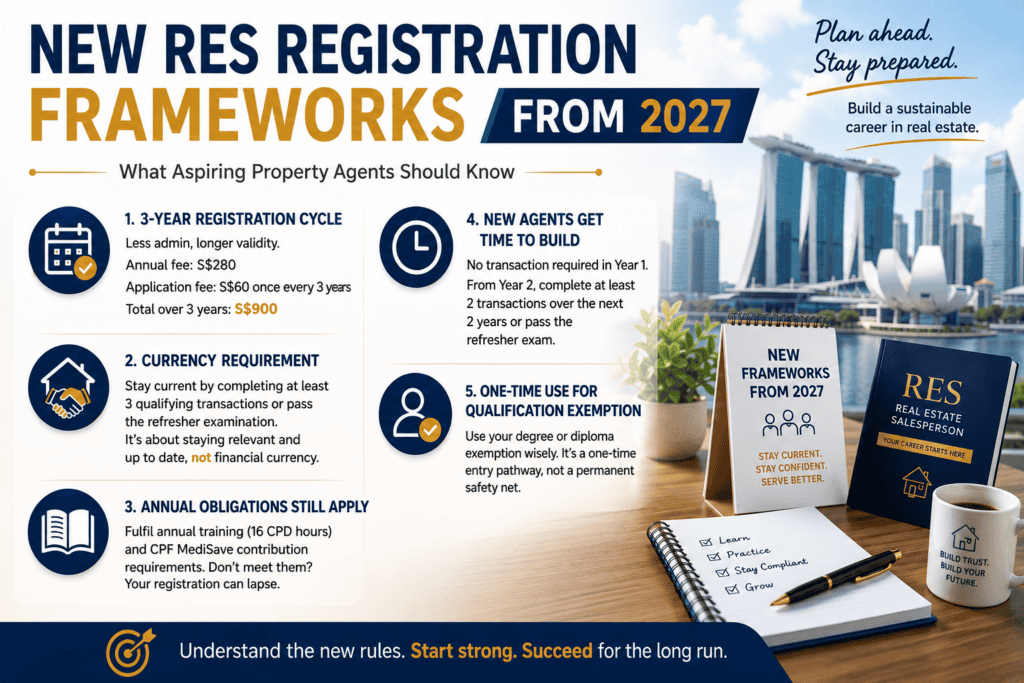
A summary of the key changes under the new RES registration framework from 2027.
A Note for Degree or Diploma Holders
If you hold a CEA-recognised real estate-related degree or diploma, you might qualify for a full or partial exemption from the RES exam.
How much exemption you get depends on your specific qualification, and for some courses, when you enrolled. Some qualifications waive both exam papers; others only get you a partial pass.
Here’s the important bit if you’re going down this route: treat your qualification exemption as a one-time entry ticket, not a reusable pass. Once you’ve used it to register the first time, don’t assume you can use it again if you later leave the industry, let your registration lapse, or come back after time away.
So before you use it, be honest with yourself about whether you’re actually ready to commit and stay active, not just get in the door.
Three Transactions Won't Automatically Pay Your Bills
Hitting three transactions over three years satisfies the minimum Currency Requirement. It doesn’t automatically mean you’re earning a living wage.
You’ll still be covering costs like:
- Agency fees
- Portal subscriptions
- Advertising
- Transport
- Training and professional development
- Insurance
- CPF planning and income tax
And commission income isn’t steady. You could spend weeks, even months, working a client without the deal ever closing.
Think of the transaction requirement as a professional floor, not an income target. It’s not a promise that the money will follow.
Rentals Are a Legitimate Way to Start
Good news, rental transactions count under the new framework too, so you don’t need to rely purely on sales to build up your experience.
Rental cases are actually a great training ground. You’ll learn how to:
- Qualify clients
- Run viewings
- Negotiate terms
- Prep documents
- Navigate tenancy procedures
- Manage handovers
All real skills that carry over.
Just don’t treat rentals as an easy way to “farm” your transaction count. There’s still compliance, proper documentation, and a client who deserves to be represented properly, no matter the deal size.
Pick Your Agency and Mentor Carefully
Passing the RES exam gives you the regulatory knowledge to get started. It won’t teach you how to actually find clients, run a smooth viewing, or handle your first case with confidence. That part comes from who’s around you.
Before you commit to a team, ask the practical questions:
- Who’s guiding your first few deals?
- Will someone check your documents and ads before they go out?
- What prospecting methods will you actually be taught?
- What costs should you expect?
- Who do you turn to when a compliance issue comes up?
A good mentor won’t just talk about awards, commissions, and “opportunity.” They’ll walk you through the actual day to day, the grind, the responsibilities, the parts nobody puts on a recruitment poster.
Give Yourself Some Financial and Personal Runway
Trust takes time to build. So do referrals and a steady pipeline of clients.
Before you take the leap, be honest about whether you’ve got enough savings to ride out a stretch of irregular income. If your family depends on your monthly income, this is a conversation worth having with them upfront, not after you’ve already started.
A solid plan for your first 12 to 24 months will serve you far better than just hoping your first deal comes quickly. Think through:
- Who you want to serve
- How you’ll consistently get in front of potential clients
- Whether you’re going full time or part time
- What you can realistically spend on marketing
- Who’s going to have your back on your early transactions
The RES Exam Is Just the Starting Line
A lot of aspiring agents put everything into passing the RES exam. Makes sense, it’s the first hurdle you can actually see.
But the real career starts after you pass.
You’ll still need to learn how to communicate clearly, prospect consistently, handle rejection (a lot of it), read market data, manage expectations, and guide clients through some of the biggest financial decisions of their lives.
The new framework really just reinforces this: your registration isn’t something you earn once and leave untouched. It needs real activity, current knowledge, and ongoing development behind it.
Final Thoughts for Aspiring RESs
The new RES registration rules shouldn’t scare off anyone who’s genuinely serious about this career.
Three transactions over three years is a manageable bar for someone actively working their business. New agents also get a full first year to build their footing before the requirement kicks in.
That said, the changes are a good nudge to walk in with your eyes open.
Don’t join just because the income potential looks good, or because someone told you this career means “freedom.” Take the time to understand how clients are actually found, how long commissions can take to come through, what your ongoing costs will look like, and what support you’ll actually get.
The best head start isn’t just passing the RES exam. It’s walking in with a clear plan, enough runway, and the right people around you, so you can build this properly, right from the start.
Key Takeaways
- RES registration moves to a three-year cycle from 1 January 2027, with total CEA fees of S$900 over the cycle.
- The Currency Requirement means completing three qualifying transactions in three years, or passing the Refresher Examination.
- New agents have no transaction requirement in Year 1, then need two transactions across Years 2 and 3.
- Annual CPD (16 hours) and CPF MediSave obligations still apply every year, regardless of the three-year cycle.
- Degree or diploma exam exemptions are a one-time entry pathway, not a reusable safety net.
- Meeting the transaction requirement is a professional minimum, not a guarantee of income.
- Rental transactions count toward the Currency Requirement and are a legitimate way to build experience.
- Choosing the right agency and mentor matters as much as passing the exam itself.
- A clear financial and personal runway plan matters more than hoping the first deal comes quickly.
Thinking About Starting Your Property Agent Career?
The new RES framework rewards agents who go in with a clear plan and the right support around them. If you’re weighing up whether this career is right for you, or trying to figure out what agency and mentorship setup makes sense, let’s talk it through.
Need Real Estate Consultation?
Contact Me
Feel free to connect with me!

Group District Director
Huttons Asia Pte Ltd
CEA Registration No.: R026434F
Agency License: L3008899K
Contact: 93839588


