

Table of Contents
For many Singapore parents house-hunting, one question comes up almost straight away: “Is this within 1km of the school?”
There has been a good reason for that. Under the current Primary 1 registration framework, when a popular school is oversubscribed in Phase 2C, a Singapore Citizen child living within 1km is considered before one living 1–2km away. Over time, that rule stopped being just a registration detail. It shaped how homes near popular primary schools were searched for, marketed and priced.
Some parents narrowed their search dramatically to stay inside that invisible 1km circle. They accepted an older development, a smaller unit, a less ideal layout or a higher price because the address carried a stronger school-distance position.
The P1 Registration 2027 changes give us a reason to look at that assumption again.
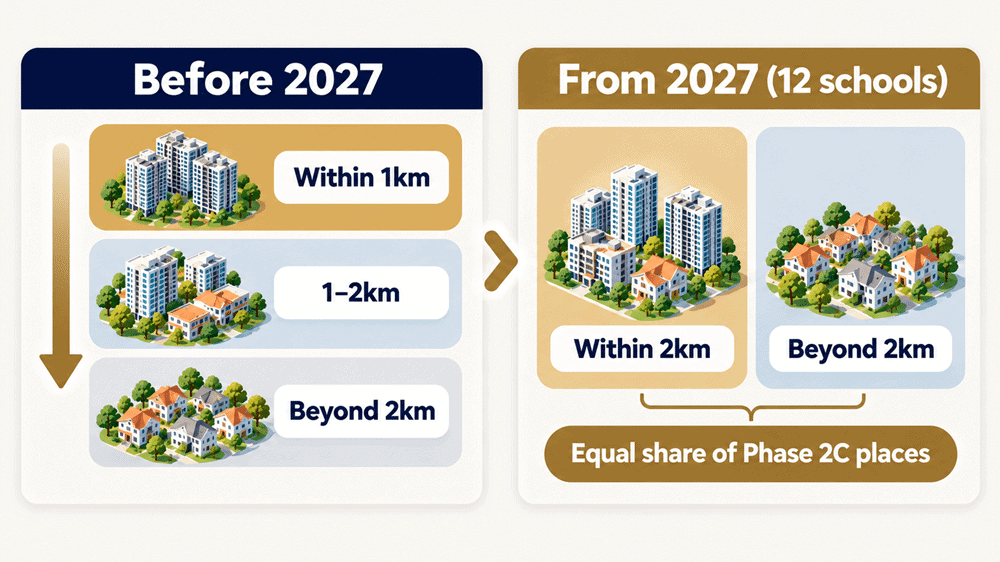
For 12 selected primary schools, MOE is splitting Phase 2C into two tracks: families living within 2km and families living beyond 2km. Within each track, there is no further home-school distance priority. A family at 800m and another at 1.8km sit in the same track, subject to citizenship priority, applicant numbers and balloting.
Does that make an 800m home and a 1.8km home the same? Of course not. Living close to school still brings real daily convenience, the 1km rule still applies in Phases 2A and 2B, and many traditional school belts are desirable for reasons that go well beyond P1 registration.
So this isn’t an article about whether the 1km premium is dead. Instead, it works through three questions:
- Who loses some of the old 1km advantage?
- Who gains from sitting 1–2km away?
- Which properties now sit in particularly attractive overlapping school catchments?
And underneath all three sits the question that matters most for your wallet:
If the registration advantage that helped support the 1km premium has changed, how much should you still be willing to pay just to cross the 1km line?
1. What Changed in the P1 Registration 2027 Rules?
There are two changes worth understanding.
Change 1: A two-track Phase 2C at 12 schools
Under the current framework, when balloting is needed, applicants are prioritised by citizenship, then home-school distance: within 1km, then 1–2km, then beyond 2km. Two homes a few streets apart could sit in very different registration positions, with a family at 950m ahead of a family at 1.1km.
From the 2027 P1 Registration Exercise (for children starting Primary 1 in 2028), the 12 selected schools will split their Phase 2C places into two tracks:
- Track 1: applicants living within 2km of the school
- Track 2: applicants living beyond 2km
At schools with 60 Phase 2C places, that works out to 30 places per track. If one track has fewer applicants than places, the unfilled places go to the other track. Within each track there is no further distance priority, but Singapore Citizens still come ahead of Permanent Residents. Places left over in one track go first to Citizens in the other track, so PRs are only considered once Citizen demand in both tracks has been met.
So two Singapore Citizen families living at 800m and 1.8km are now on equal footing for distance within Phase 2C. Whether their odds are equal is a different question, which Section 8 covers.
Change 2: More reserved Phase 2C places
Most schools currently reserve 40 places for Phase 2C. From 2027, most will reserve 60, while smaller schools with P1 intakes below 180 stay at 40. The extra places come from the earlier phases, and Phase 2B keeps its 20 reserved places.
In practice, more places are protected for families without alumni links, sibling priority or other connections. Whether that improves your chances at a particular school still comes down to how many other families apply.
The 12 schools under the two-track scheme
| # | School | Property belt |
|---|---|---|
| 1 | Anglo-Chinese School (Junior) | Newton / Stevens / Orchard fringe |
| 2 | Anglo-Chinese School (Primary) | Newton / Stevens / Orchard fringe |
| 3 | Singapore Chinese Girls’ Primary School | Newton / Stevens / Orchard fringe |
| 4 | St. Margaret’s School (Primary) | Newton / Stevens / Orchard fringe |
| 5 | Methodist Girls’ School (Primary) | Bukit Timah / Beauty World |
| 6 | Nanyang Primary School | Bukit Timah / Beauty World |
| 7 | Pei Hwa Presbyterian Primary School | Bukit Timah / Beauty World |
| 8 | Raffles Girls’ Primary School | Bukit Timah / Beauty World |
| 9 | CHIJ (Katong) Primary | Katong / East Coast |
| 10 | Ngee Ann Primary School | Katong / East Coast |
| 11 | Tanjong Katong Primary School | Katong / East Coast |
| 12 | Tao Nan School | Katong / East Coast |
MOE selected these schools because public housing makes up less than 40% of homes within 2km of each of them. The aim is to broaden access and student mix.
The key property takeaway: for Phase 2C at these 12 schools, being within 1km no longer gives an applicant a distance advantage over someone living between 1km and 2km.
2. The 12 Schools Are Not One Property Market
It’s tempting to treat the 12 schools as one group. But would a scarce freehold home near Nanyang Primary really behave like a large condo cluster in Katong? And would a project inside the 2km circle of four affected schools tell the same story as one that relies on a single school?
I find it more useful to think in the three residential belts grouped in the table above.
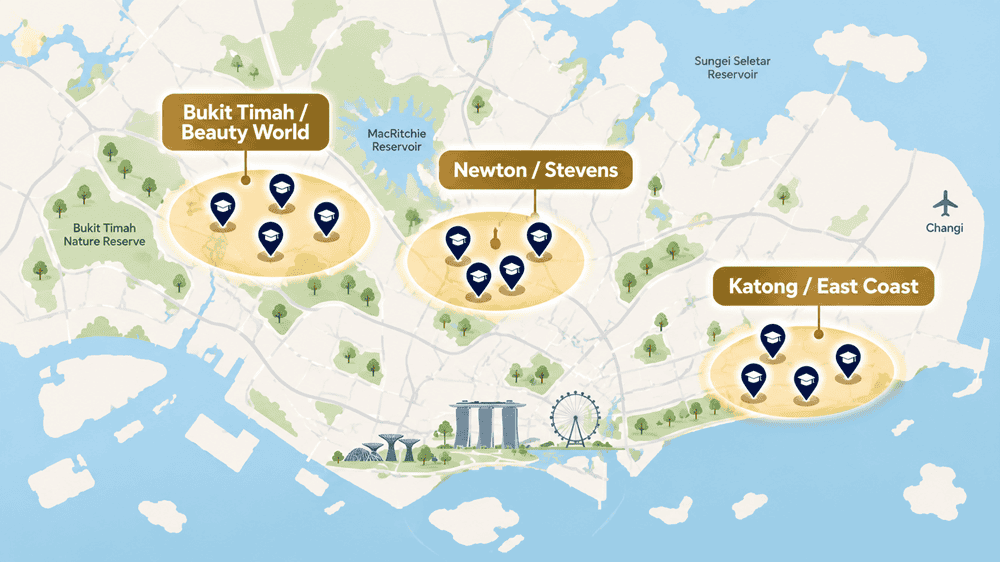
Newton / Stevens / Orchard fringe (D09, D10, D11)
The overlap belt. Several developments here sit within the catchments of two, three or even four affected schools.
Bukit Timah / Beauty World (D10, D11, D21)
The scarcity belt. Demand here has always been strongly school-driven, but supply varies a lot. Some pockets are dominated by scarce landed and established resale stock, while others have new launches and direct substitutes.
Katong / East Coast (D15)
The comparison belt, and probably the most visible test case, because recent launches are concentrated across overlapping school circles, giving buyers plenty of direct comparisons.
Same rule, different outcomes. Supply, tenure, MRT access, land scarcity, project quality and the number of competing homes will all shape how each belt responds. Section 5 looks at each belt through specific projects.
3. Is the 1km School Property Premium Still Relevant?
Yes, but it now needs a different justification.
The new rule weakens the monopoly of the 1km ring. It does not eliminate the value of living close to a good school.
Within 1km still counts in Phases 2A and 2B, where home-school distance is used when balloting is needed, and at every school outside the two-track scheme. What changes is Phase 2C at these 12 schools, which is exactly where families without prior connections compete.
The old 1km premium was partly backed by a genuine Phase 2C advantage. Consider two otherwise similar homes:
- Property A: 850m from the school, asking $3.2 million
- Property B: 1.3km from the same school, asking $2.9 million
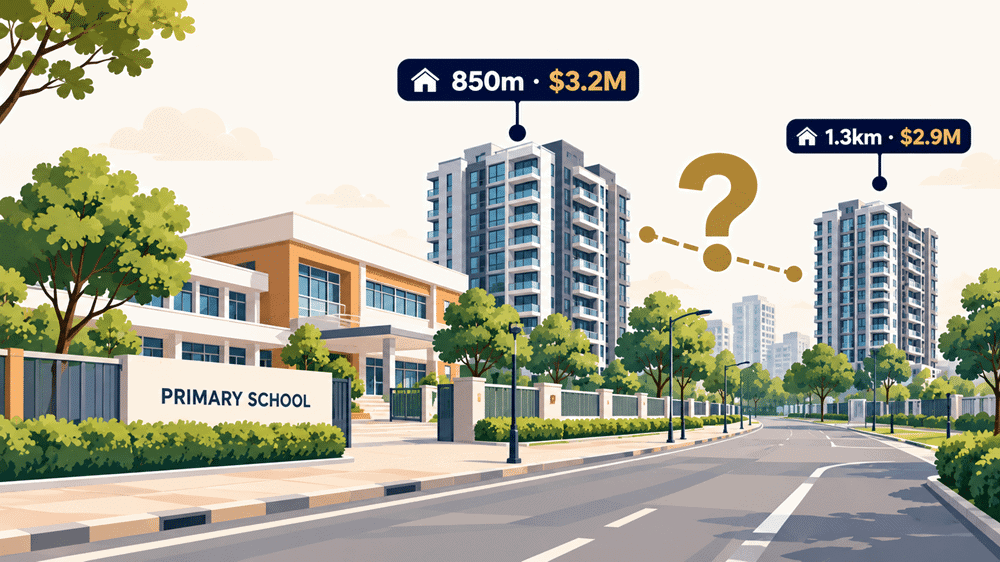
Previously, part of that $300,000 gap could be explained by Property A’s stronger Phase 2C distance position. From 2027, at these 12 schools, that particular advantage disappears. So the question shifts from “How much do I pay to get inside 1km?” to “What am I actually getting for the extra $300,000?”
If Property A is genuinely walkable to school, closer to the MRT, freehold, larger, quieter or within several desirable catchments, the premium may still make sense. It’s now a location and quality premium rather than a registration one.
If Property A is older, smaller, further from the MRT and noticeably more expensive, with “within 1km” as its main selling point, what exactly is the extra money buying?
The zone I’d watch most closely is the edge of the old boundary, roughly 900m to 1.5km. A condo at 950m used to be marketed very differently from one at 1.05km. The physical difference was small; the registration difference wasn’t. At these 12 schools, that Phase 2C distinction is now gone.
That doesn’t point to a sudden price drop for the 950m home. What’s more likely is that the gap between comparable homes on either side of the line becomes harder to justify. I unpack that in my market take in Section 11.
4. How Each Distance Band Is Affected
Within 1km
These homes lose one layer of exclusivity in Phase 2C. They no longer sit ahead of the 1–2km group on distance, and, as Section 8 shows, within-1km families now share a smaller slice of places. The best of them stay highly desirable for walkability, scarcity, tenure, transport and multiple-school overlap.
For owners, the useful question isn’t “Has my home lost its school premium?” It’s “How much of my premium depended purely on the old Phase 2C rule?”
1–2km
This is the band I find most interesting. For years, many parents dismissed these homes with a quick “too bad, outside 1km”. At the 12 schools, that Phase 2C disadvantage is gone. A home at 1.3km is no longer second tier on distance compared with one at 800m.
So is every 1–2km home now a bargain? A weak property is still a weak property. But a good development that was discounted mainly for sitting outside 1km may deserve a fresh look, especially one with sensible pricing, a good layout, transport, tenure and exit demand. Its school-access story has improved without the buyer having paid the historical premium.
Beyond 2km
This is the quietest change. The new scheme reserves a track for applicants living beyond 2km. Families further away won’t suddenly have easy odds, but they may feel less pressure to relocate just to have a meaningful Phase 2C chance.
Some families will still move. Others may decide the cost and disruption of relocating isn’t worth it. If enough families think that way, some of the urgency behind school-driven housing demand could ease. That’s worth watching rather than assuming.
5. Which New Launches May Deserve a Fresh Look?
This is where the policy becomes easier to picture. The aim isn’t to name winners, but to spot projects whose relative school-access position has improved.
How to read the tables: distance bands are taken from OneMap’s School Query (checked in September 2026, using data updated in June 2026). Only the 12 affected schools are shown. Home-school distance is measured from each block’s building outline, so blocks in the same project can fall into different bands. Projects marked † are not yet listed in the School Query, so their bands are estimates from OneMap map data. Always recheck a specific address, especially after the June 2027 update.
Abbreviations: TKPS – Tanjong Katong Primary; CHIJ (Katong) – CHIJ (Katong) Primary; MGS – Methodist Girls’ School (Primary); RGPS – Raffles Girls’ Primary; ACS (J) / ACS (P) – Anglo-Chinese School (Junior) / (Primary); SCGS – Singapore Chinese Girls’ Primary.
These tables only cover the 12 schools under the new two-track scheme. Many projects are also near other popular primary schools, such as St. Joseph’s Institution Junior in the Newton belt. At those schools, the existing Phase 2C order still applies, so being within 1km continues to give an advantage. If a specific school outside the 12 matters to your family, check it separately on OneMap.
Katong / East Coast (D15)
The clearest cluster, as several recent launches sit within 2km of multiple affected schools.
| Project | Within 1km | 1–2km |
|---|---|---|
| Tembusu Grand | TKPS | CHIJ (Katong), Tao Nan |
| The Continuum | TKPS | CHIJ (Katong), Tao Nan |
| Ardor Residence | TKPS | CHIJ (Katong), Ngee Ann, Tao Nan |
| Atlassia | TKPS | CHIJ (Katong), Ngee Ann, Tao Nan |
| Claydence | CHIJ (Katong), Tao Nan | Ngee Ann, TKPS |
| Grand Dunman | TKPS (some blocks) | TKPS (other blocks) |
| Meyer Blue | – | TKPS |
| Arina East Residences | – | TKPS |
| The Line @ Tanjong Rhu | – | TKPS |
Standout for P1 2027: Ardor Residence and Atlassia. Under the old rules, only one affected primary school gave these projects top Phase 2C distance priority: Tanjong Katong Primary, which is within 1km. CHIJ (Katong), Ngee Ann and Tao Nan, all 1–2km away, were treated as backup options, because families there sat behind the within-1km group. From 2027, residents sit in the same within-2km track for all four of these primary schools. What looked like “one strong school plus three weaker options” now reads as “four primary schools on equal Phase 2C distance footing”.
Grand Dunman shows why the exact address matters. Some of its blocks are within 1km of TKPS, while others fall in the 1–2km band. Under the old rules, that difference mattered in Phase 2C. At TKPS from 2027, it no longer does.
With so many comparable projects side by side, Katong is also where buyers have the most substitutes, and where a premium tied to one distance band is most likely to be questioned.
Bukit Timah / Beauty World / Pine Grove (D10, D21)
Here the story revolves mainly around Pei Hwa and MGS.
| Project | Within 1km | 1–2km |
|---|---|---|
| 8@BT | Pei Hwa | MGS |
| The Sen | – | Pei Hwa |
| Nava Grove | – | MGS, Pei Hwa |
| Pinetree Hill | – | MGS, Pei Hwa |
| Amberwood at Holland † | MGS | Pei Hwa (RGPS close to the 2km line) |
| Dunearn House † | MGS (close to the 1km line) | RGPS, Pei Hwa, Nanyang (close to the 2km line) |
| Villas @ Greenbank Park † | – | MGS, Pei Hwa |
Standout for P1 2027: Dunearn House. Under the old rules, MGS was the one affected primary school where it looked set to enjoy top Phase 2C distance priority. From 2027, it may sit in the within-2km track for up to four affected schools: MGS, RGPS, Pei Hwa and Nanyang. Two caveats apply. It isn’t yet listed in OneMap’s School Query, and Nanyang sits close to the 2km line, so this is one to recheck once the address is registered.
Around Pei Hwa, 8@BT is the within-1km project, while The Sen, Nava Grove, Pinetree Hill, Amberwood at Holland, Dunearn House and Villas @ Greenbank Park sit in the 1–2km band. Previously, 8@BT held the clearer Phase 2C advantage. From 2027, buyers can compare these projects on a level distance basis and ask: is the within-1km project still worth its premium, or does another offer better value, layout, MRT access or long-term fundamentals?
The Sen is a good illustration. Neither the project nor the school has moved; only the rule separating the two bands has. That’s a relative improvement in school-access positioning, not an upgrade to the property itself.
Around MGS, Amberwood at Holland and Dunearn House appear to be the within-1km options, while 8@BT, Nava Grove and Pinetree Hill are in the 1–2km band. Nava Grove and Pinetree Hill are also within 2km of Pei Hwa, so their residents now sit in the within-2km track for two affected schools. The old “near, but not within 1km” objection carries less weight, which is a reason to compare these projects more seriously rather than to assume they have become better.
Newton / Stevens / Orchard fringe (D09, D10, D11)
Probably the strongest multiple-school overlap story.
| Project | Within 1km | 1–2km |
|---|---|---|
| 10 Evelyn | ACS (J), ACS (P) | SCGS, St. Margaret’s |
| Reignwood Hamilton Scotts | ACS (J), ACS (P) | SCGS, St. Margaret’s |
| The Giverny Residences | ACS (P), SCGS | ACS (J) |
| The Oliv | ACS (P), SCGS | ACS (J), St. Margaret’s |
| 21 Anderson | ACS (P), SCGS | ACS (J) |
| Lucida | ACS (J) | ACS (P), SCGS, St. Margaret’s |
| Residences at Emerald Hill | ACS (J), St. Margaret’s | ACS (P); SCGS (some blocks) |
Standout for P1 2027: Lucida. Under the old rules, only ACS (Junior) gave it top Phase 2C distance priority, as the one affected school within 1km. From 2027, it sits in the within-2km track for all four schools in this belt: ACS (Junior), ACS (Primary), SCGS and St. Margaret’s. (See the note on ACS (Primary) below for how this changes from 2030.)
For now, every project here sits within 2km of at least three affected schools, and 10 Evelyn, Reignwood Hamilton Scotts, The Oliv and Lucida reach all four. Here the appeal may shift from one specific school to having several realistic choices. That’s especially useful for parents buying early, before they know which school they will eventually target.
A note on ACS (Primary). MOE announced in 2023 that ACS (Primary) will relocate from Barker Road to Tengah, taking in its first Primary 1 cohort there in 2030. After that, the Barker Road campus will only admit younger brothers of existing students, before consolidating with ACS (Junior) around 2033. ACS (Junior) itself is expected to move to the Barker Road campus around 2039. So for the projects above, the ACS (Primary) link mainly matters for children entering Primary 1 in 2028 and 2029. If your child will enter Primary 1 in 2030 or later, read the table without ACS (Primary), and note that ACS (Junior) distances may change once it moves.
St. Margaret's / city fringe
A large pool of projects sits within 2km of St. Margaret’s, and most of them are also within 2km of ACS (Junior).
| Project | Within 1km | 1–2km |
|---|---|---|
| Sophia Meadow † | St. Margaret’s, ACS (J) | ACS (P) (close to the 2km line) |
| Duet @ Emily † | St. Margaret’s, ACS (J) | – |
| The Collective at One Sophia | St. Margaret’s | ACS (J) |
| The Ranz | – | ACS (J), ACS (P), St. Margaret’s |
| Promenade Peak | – | ACS (J), St. Margaret’s |
| CanningHill Piers | – | ACS (J), St. Margaret’s |
| Eden Residences Capitol | – | ACS (J), St. Margaret’s |
| Lloyd SixtyFive | – | ACS (J), St. Margaret’s |
| River Green | – | ACS (J), St. Margaret’s |
| River Modern † | – | ACS (J), St. Margaret’s |
| The Lumos | – | ACS (J), St. Margaret’s |
| The Robertson Opus | – | ACS (J), St. Margaret’s |
| Grange 1866 | – | ACS (J), St. Margaret’s |
| Union Square Residences † | – | St. Margaret’s |
| Midtown Bay | – | St. Margaret’s |
Standout for P1 2027: The Ranz. Under the old rules, it had no affected school within 1km, so it never enjoyed top Phase 2C distance priority at any of them. From 2027, it sits in the within-2km track for three: ACS (Junior), ACS (Primary) and St. Margaret’s. That’s a big shift for a project that would once have been described as merely “near” these schools.
With this much choice, does “within 2km” really set a project apart? A larger catchment also means a larger applicant pool and more alternatives for buyers.
Nanyang and Raffles Girls' Primary
Compared with Katong or Newton, there are far fewer new launches around Nanyang Primary and Raffles Girls’ Primary. Dunearn House appears to sit within 1–2km of RGPS, though it isn’t yet listed in OneMap’s School Query.
That scarcity matters. With fewer new-launch substitutes, scarce landed homes, freehold stock and prestigious enclaves, the school rule is only one part of the value equation. A rare family-sized home on a sought-after street may keep much of its premium even as the Phase 2C distance advantage narrows, because the buyer is also paying for land scarcity, neighbourhood quality and long-term family demand.
This is why the policy is likely to show up more clearly in dense condo markets than in areas dominated by limited, prestigious housing stock.
6. Could Multiple-School Catchment Become the New Premium?
For years, the conversation revolved around one number: 1km. At these 12 schools, another question may become just as important: how many desirable schools is this home within 2km of?
Picture two homes:
- Property A: 800m from one affected school
- Property B: 1.3km from one, 1.6km from another and 1.8km from a third
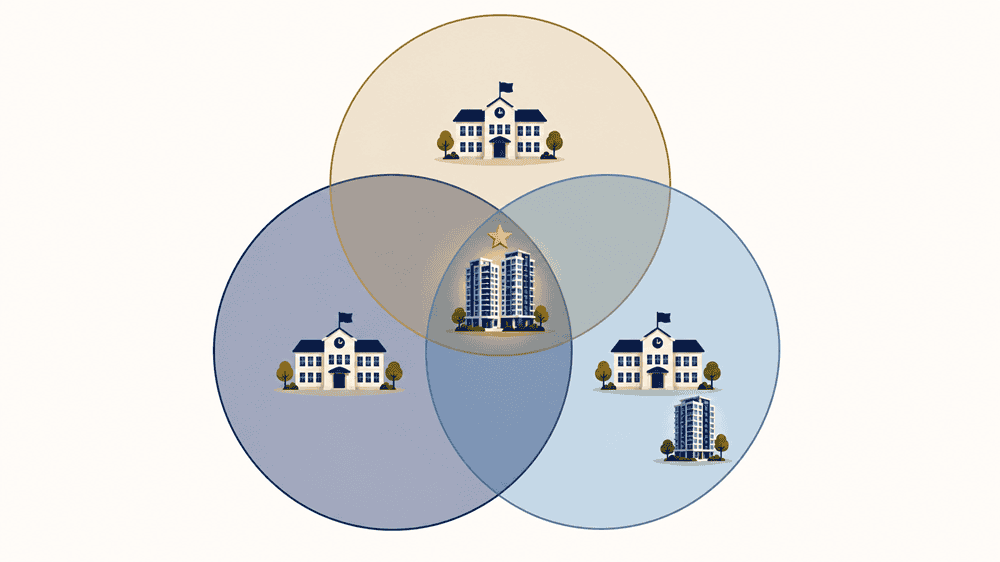
Under the old framework, Property A held the obvious Phase 2C advantage. From 2027, Property B may sit in the within-2km track for all three schools.
Which would you choose? It depends, and that’s the point. Many parents buy years before P1 registration. They may not yet know which school will be their first choice, how competitive it will be that year, whether their circumstances will change, or whether they will qualify through an earlier phase. An address inside several relevant catchments gives them room to adjust.
The strongest examples today sit in the overlapping D09, D10 and D11 belt around Newton and Stevens, and in D15 around Katong, where several new launches fall within 2km of three or four affected schools.
Not all overlaps are equal, though. How competitive are the schools? How many homes share the catchment? Does the property make sense on its own? Skip those questions and “multiple schools within 2km” simply becomes the next marketing shortcut.
The strongest school-location homes may increasingly combine three layers:
- At least one genuinely convenient school nearby
- Several desirable schools within the relevant distance band
- Strong property fundamentals
7. Future Supply Could Change the Equation Again
A wider 2km track brings more homes into the conversation, but it can also bring in more applicants.

Turf City / Bukit Timah
Turf City is planned as a major new residential area with roughly 15,000 to 20,000 public and private homes over the longer term. Depending on exact site boundaries and official distance calculations, parts of it fall within the orbit of sought-after Bukit Timah schools such as RGPS and MGS. The first Dunearn Road sites are already progressing, with more expected over time.
Future projects there may enter valuable catchments under a friendlier Phase 2C structure. At the same time, thousands of new homes mean more families competing in the same within-2km track. The school-access story could improve while the ballot gets tougher.
Newton / Monk's Hill
URA’s plans for Newton and Monk’s Hill include a significant housing pipeline around Newton Circus, Scotts Road and the surrounding area, close to several affected schools. New homes and better amenities can lift the neighbourhood, and a larger residential population can also add more families to the same catchments.
Schools can move too, as the ACS (Primary) note in Section 5 shows. Being within 2km is useful information today. How might that picture look in five years, once the new supply is lived in?
8. Equal Distance Priority Does Not Mean Equal Admission Odds
If there’s one caution in this article worth underlining, it’s this one.
When parents hear that 800m and 1.8km applicants are now in the same track, it’s natural to assume they have the same chance. What actually becomes equal is the distance priority within the track. Admission odds still depend on:
- citizenship
- the number of applicants in the track
- the number of places available
- how popular the school is that year
- how much new housing has been completed in the catchment
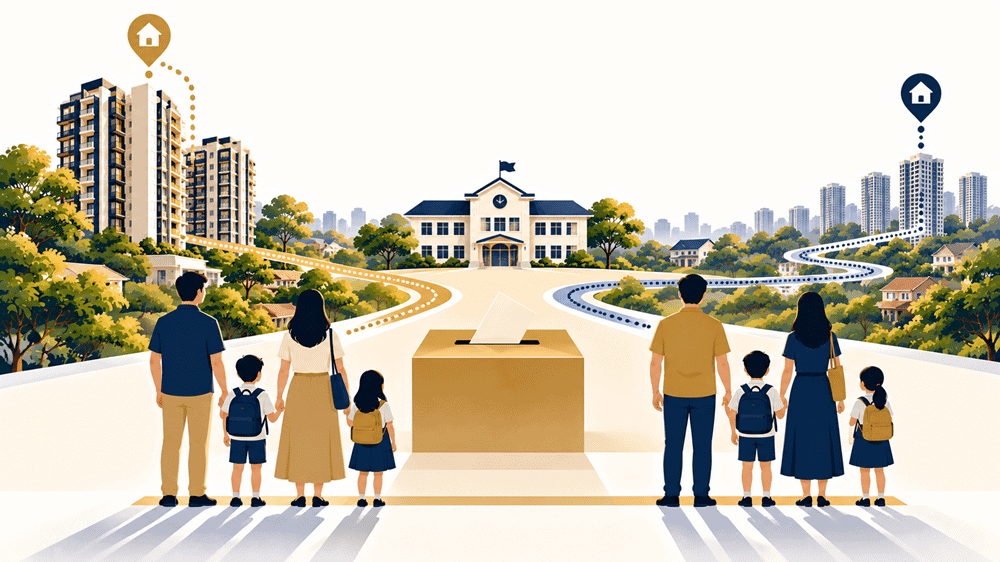
Within-1km families now compete for fewer places
There’s another side to this that often gets missed. Under the old rules, when one of these schools was oversubscribed, Singapore Citizen families within 1km had first claim on the entire Phase 2C pool: the reserved places plus any left over from earlier phases. From 2027, that whole pool is split equally between the two tracks, so within-1km families share their half with every Citizen applicant up to 2km (plus any spillover from the other track).
More places overall, but a smaller share for within-1km families and a bigger pool competing for it. That, more than anything, is why the within-1km moat narrows.
Same footing, still a ballot
Suppose the within-2km track has 30 places and 120 eligible Singapore Citizen applicants. The family at 1.5km is no longer behind the family at 800m on distance, but both are in a very competitive ballot.
So the accurate reading isn’t “1–2km now has good odds”. It’s “1–2km no longer carries the old distance disadvantage”. That’s meaningful, but it isn’t the same as easier admission.
This is also where multiple-school overlap earns its keep. It doesn’t improve the odds at any one school, but it gives a family more viable options rather than a single outcome to depend on.
9. Should Buyers Still Pay for Within 1km?
Sometimes, yes. The real question is what the premium is paying for.
There’s genuine value in daily convenience. A home five to eight minutes’ walk from school is very different from one that is technically within 2km but still needs a drive every morning. Over six years of school runs, CCAs, rainy days and pick-ups, that adds up. So the 1km premium may well survive, but increasingly as a convenience and quality premium rather than a registration-rule premium.
The question to settle before paying it is simple: would you still buy this property if the school factor disappeared? If yes, it stands on its own fundamentals. If not, how comfortable are you paying extra for it?
Or, put another way: would you buy a mediocre property at 900m when a much stronger one at 1.3km now gives you the same Phase 2C distance status?
It’s also worth knowing where 1km still counts. Phases 2A and 2B keep home-school distance priority. So if you plan to become a parent volunteer, or qualify through a church or clan link in Phase 2B, living within 1km can still make a difference when that phase is balloted.
One more practical point: if your child secures a place based on your home address, MOE generally requires you to live at that address for at least 30 months from the start of the registration exercise. That’s another reason the home itself has to work for your family, not just the school.

A simple buyer checklist
Before paying a school-related premium, I’d work through these:
- Which registration phase will my family actually use? (The change discussed here applies to Phase 2C at these 12 schools.)
- Am I choosing within 1km for walkability, or mainly for the old Phase 2C advantage?
- What are the strongest alternatives between 1km and 2km, and how much cheaper are they?
- Is the within-1km home genuinely better in layout, tenure, MRT access, surroundings, facilities and future demand?
- How many desirable schools does this address overlap, and how competitive are they?
- How much new housing is coming into the same catchment?
- Would I still buy this property without the school factor?
- Would I be comfortable holding it after my child finishes primary school?
A home should ideally keep making sense after the school objective has been achieved. If it only works for one narrow stage of family life, that’s worth weighing before paying a large premium.
10. What Should Sellers Inside the Old 1km Ring Do?
Not panic. Reposition.
Previously, a listing could lean on one line:
“Within 1km of Nanyang Primary.”
From 2027, a stronger message for homes near these 12 schools might be:
“Walkable to Nanyang Primary, within the wider catchment of several desirable schools, close to transport and amenities, and one of the few family-sized homes available in the area.”
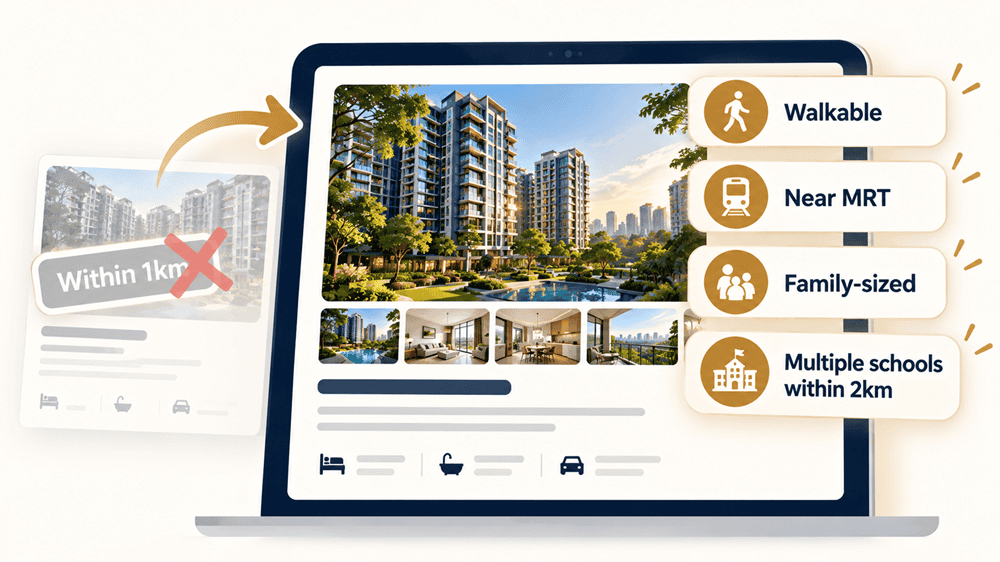
In other words, shift the value story from registration priority to quality of location.
Expect better-informed buyers, too. Sooner or later, someone will ask: “Why should I pay so much more for this 900m home when a project at 1.3km gives me the same Phase 2C distance status?”
There may be good answers: far better walkability, freehold tenure, larger family layouts, stronger MRT access, multiple-school overlap or limited competing supply. But those strengths now need to be spelt out rather than assumed.
Pricing needs the same rethink. Instead of benchmarking only against other within-1km listings, look at comparable projects between 1km and 2km, because those are now real substitutes for Phase 2C buyers. The competitive set has widened.
A simple seller checklist
- Is my property genuinely walkable to the school?
- Which other affected schools are within 2km?
- How does my asking price compare with good 1–2km alternatives?
- What advantages does my home have beyond the school label?
- Is my unit scarce in size, tenure, layout or location?
- Am I still marketing it on an assumption that informed buyers may now challenge?
11. My Market Take: Expect Compression Before Correction
Will this policy move prices? Possibly, but I don’t expect an immediate or dramatic repricing.
The first shift is more likely to show up in buyer behaviour. Parents who used to search only within 1km may widen their search to the full 2km catchment. That adds alternatives and forces the within-1km home to compete harder on price, layout, tenure, transport and liveability.
That’s why I prefer the word “compression” to “correction”. Go back to the $300,000 gap between Property A at 850m and Property B at 1.3km. The policy doesn’t necessarily push Property A’s price down sharply. It may simply make buyers less willing to pay the full $300,000. Before any visible price re-rating, some 1–2km projects may first see more enquiries, more viewings and more buyer acceptance.
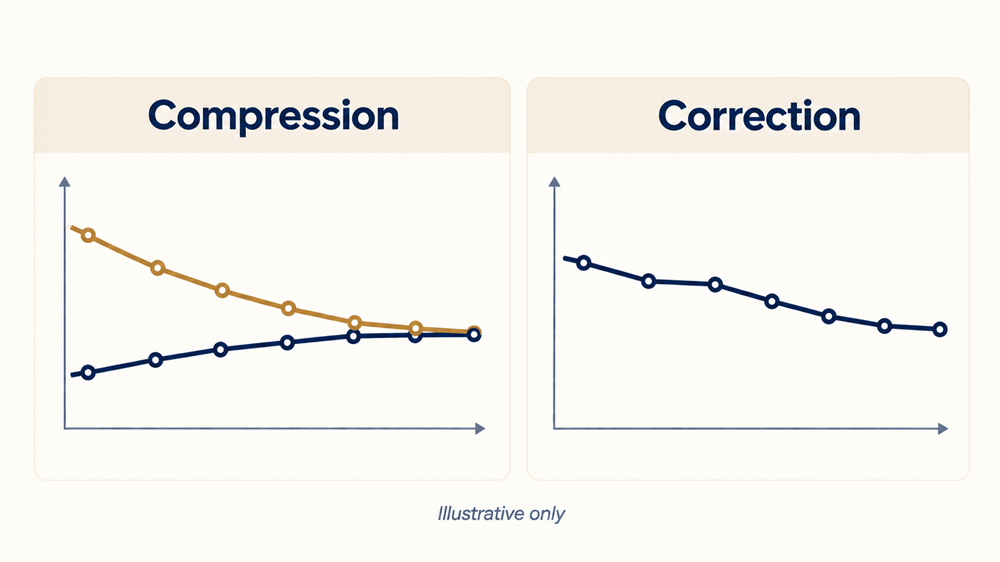
The pace will differ by belt. Katong may show it fastest because of its many comparable condos across overlapping school circles. Bukit Timah may move more slowly, with scarcity, landed stock and prestige supporting values independently of school distance. The strongest, scarcest homes may keep much of their premium.
If I had to sketch it out:
- Potential relative winners: 1–2km homes with strong fundamentals, projects overlapping several affected schools, and new launches previously marketed as merely “near” a prestigious school.
- Potentially more exposed: homes whose asking premium leaned heavily on the within-1km label, with little else to justify the gap.
It’s also worth remembering that this is a story about 12 schools, not every school. At other popular primary schools, the extra Phase 2C places still follow the usual order, with Citizens within 1km considered first. So near those schools, a within-1km home may become slightly more useful for Phase 2C, not less. The 1km premium isn’t weakening everywhere; it’s being re-sorted school by school.
I also don’t expect the market to absorb this overnight. Many sellers will keep using the old 1km narrative, and many buyers may only feel the difference once the first 2027 Phase 2C results are out. So the next 12 to 24 months may be more about information advantage than price appreciation. And sometimes, avoiding an unnecessary premium is worth as much as buying something that appreciates faster.
What I'd watch over the next 12 to 24 months
Because the rule is new, the most useful evidence will only appear as parents and buyers react. These are the five signals I’d follow:
- Listing language. Do agents shift from “within 1km” to “within 2km of multiple popular schools”? That would be an early sign the narrative is changing.
- Enquiry behaviour. Do buyers who insisted on within 1km start viewing homes at 1.2km, 1.5km or 1.8km? That matters even before prices move.
- Price gaps across the old line. For two projects similar in age, tenure, location and quality, does the gap start to narrow?
- P1 application data. Do the within-2km tracks attract substantially more applicants? If competition rises sharply, it may temper some of the excitement around 1–2km homes.
- Developer marketing. Do new launch brochures start highlighting several schools within 2km instead of one within 1km? That would tell us the market has absorbed the rule.
No single signal proves values have changed. Together, they will show whether the 1km premium is being redefined.
12. The Question Has Changed
For years, the school-property conversation in Singapore ran on one shortcut: “Is this property within 1km?” That question still matters, but for these 12 schools it’s no longer enough on its own.
For buyers, the practical strategy is to widen the search before narrowing the choice. Look at the full 2km catchment and compare properly.
For sellers, the 1km story needs to grow into a broader family-location story.
For investors, don’t buy the policy. Buy the property. A 1–2km home isn’t a good investment just because its Phase 2C position improved, just as a within-1km home isn’t a poor one because one part of its moat has narrowed.
The old framework encouraged a binary mindset: inside 1km or outside. At these 12 schools, a more useful question is:
Which address gives my family the best combination of school access and property value?
The 1km circle hasn’t disappeared. It’s just no longer the only circle that matters. And if the rule has changed, perhaps the way we value the school-distance premium should change too.
Frequently Asked Questions on P1 Registration 2027
When do the P1 Registration 2027 changes take effect?
From the 2027 P1 Registration Exercise, for children starting Primary 1 in 2028. The 2026 exercise follows the existing rules.
Which schools use the new Phase 2C two-track scheme?
Anglo-Chinese School (Junior), Anglo-Chinese School (Primary), CHIJ (Katong) Primary, Methodist Girls’ School (Primary), Nanyang Primary, Ngee Ann Primary, Pei Hwa Presbyterian Primary, Raffles Girls’ Primary, Singapore Chinese Girls’ Primary, St. Margaret’s School (Primary), Tanjong Katong Primary and Tao Nan School.
How are Phase 2C places split between the two tracks?
Equally. At schools with 60 Phase 2C places, 30 go to applicants within 2km and 30 to applicants beyond 2km. Unfilled places in one track go to the other. Within each track, Singapore Citizens have priority over Permanent Residents, and balloting applies if the track is oversubscribed.
Does living within 1km of a school still matter?
Yes. Home-school distance priority still applies in Phases 2A and 2B and at schools outside the scheme. At the 12 schools, within Phase 2C, applicants within 1km and those 1–2km away are simply in the same track. Walkability also remains a real daily benefit.
Do Permanent Residents benefit from the two-track scheme?
Not directly. Singapore Citizens still come ahead of PRs in each track, and places left over in one track go first to Citizens in the other track. PRs are only considered once Citizen demand in both tracks has been met.
Do I need to live at the registered address after my child gets a place?
Generally, yes. If your child secures a place based on your home address, MOE requires you to live at that address for at least 30 months from the start of the P1 Registration Exercise. Check the MOE website for the full residency requirements.
What happens when ACS (Primary) moves to Tengah?
MOE has announced that ACS (Primary) will relocate from Barker Road to Tengah, taking in its first Primary 1 cohort there in 2030. After that, the Barker Road campus will only admit younger brothers of existing students before consolidating with ACS (Junior). For homes near Barker Road, the ACS (Primary) link mainly matters for children entering Primary 1 in 2028 and 2029.
Will prices of homes within 1km of these schools fall?
Not necessarily. My view is that the price gap between comparable homes just inside and just outside 1km is more likely to narrow gradually than for within-1km prices to drop sharply. Scarce, well-located homes may hold much of their premium.
Important Note
Home-school distance should always be verified using the official MOE / OneMap home-school distance checker for the specific residential address. School admission is never guaranteed by distance alone. Policy details are based on MOE’s announcement of 10 September 2026; please check the MOE website for the latest updates.
Weighing Up a Specific Address?
If you’re comparing a within-1km home against 1–2km alternatives near one of these 12 schools, I’m happy to walk through it with you using my PrimeKey Analysis: school overlap, pricing gaps, and how the home holds up without the school factor. No pressure, just a clearer picture.
WhatsApp: +65 9383 9588
Darren Ong | Group District Director, Huttons Asia Pte Ltd | CEA Reg. No. R026434F. This article is for general information only and does not constitute financial, legal or school admission advice.
Need Real Estate Consultation?
Contact Me
Feel free to connect with me!

Group District Director
Huttons Asia Pte Ltd
CEA Registration No.: R026434F
Agency License: L3008899K
Contact: 93839588
P1 Registration 2027: Which Condos Gain From the New 2km Rule?
MOE’s 2027 P1 registration changes remove the within-1km Phase 2C advantage at 12 popular schools. Which condos gain from the new 2km rule, and how should buyers and sellers rethink the 1km school premium?

What are Prime Location Public Housing (PLH), Plus and Standard Model and Its Effect
Prime Location Public Housing (PLH), Plus and Standard HDB model on future new BTO located in City centre and Greater Southern Waterfront. Understand more here.
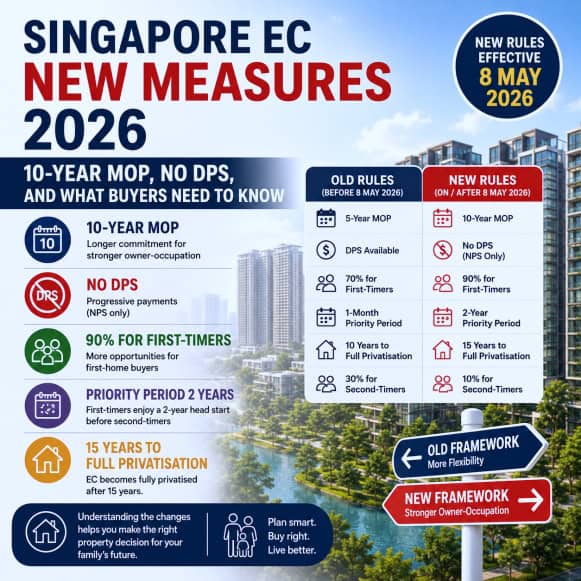
Singapore EC New Measures 2026: What Every Buyer Needs to Know Before Making Their Next Move
Singapore’s EC rules changed on 8 May 2026 — 10-year MOP, no Deferred Payment Scheme, a higher first-timer quota, and a long first-timer priority period. Here’s what it really means for your next property move.

Where Can You Find and How to Buy an Upcoming Executive Condominium (EC) in 2026
Updated with New EC Rules 2026
. Buying Exec Condo EC Guides 2026. Rivelle at Tampines EC, Coastal Cabana EC at Pasir Ris. Other Upcoming New Launch EC include Senja Close, Woodlands Dr 17 and Sembwang Road site. Purchase Procedures Guides Available. Connect for more info now.

9 Tips to Choose a Good Unit in a Resale Condominium in Singapore
Choosing a resale condo in Singapore? Here are 9 tips on liquidity, layout, facing, lease decay, schools, future growth, and value for money to guide you.

12 Tips to Choose a Good Unit in a New Launch Condominium Project
12 practical tips for choosing a good unit in a new launch condo in Singapore — facing, floor level, layout efficiency, and price benchmarking explained.


