
Table of Contents
Let me be straight with you.
If you’ve been watching the EC market, waiting for the right time, quietly doing your research, or maybe already balloting. The government just moved the goalposts in a very significant way.
On 8 May 2026, Minister for National Development Chee Hong Tat announced three sweeping policy changes to Singapore’s Executive Condominium scheme. Described by the Ministry of National Development as the most significant revision to EC rules since 2013, these measures are not minor tweaks. They fundamentally reshape who ECs are for, how long you’ll be holding them, and what it costs to get in.
Depending on where you are in your property journey, this could be great news or a signal to seriously rethink your plan.
This article will walk you through exactly what changed, why the government acted now, what it means for you in plain language, and how to think clearly about your next step.
Before we get into the new rules, it helps to understand why the government felt compelled to act.
The EC market had become, to put it plainly, a very profitable flipping machine.
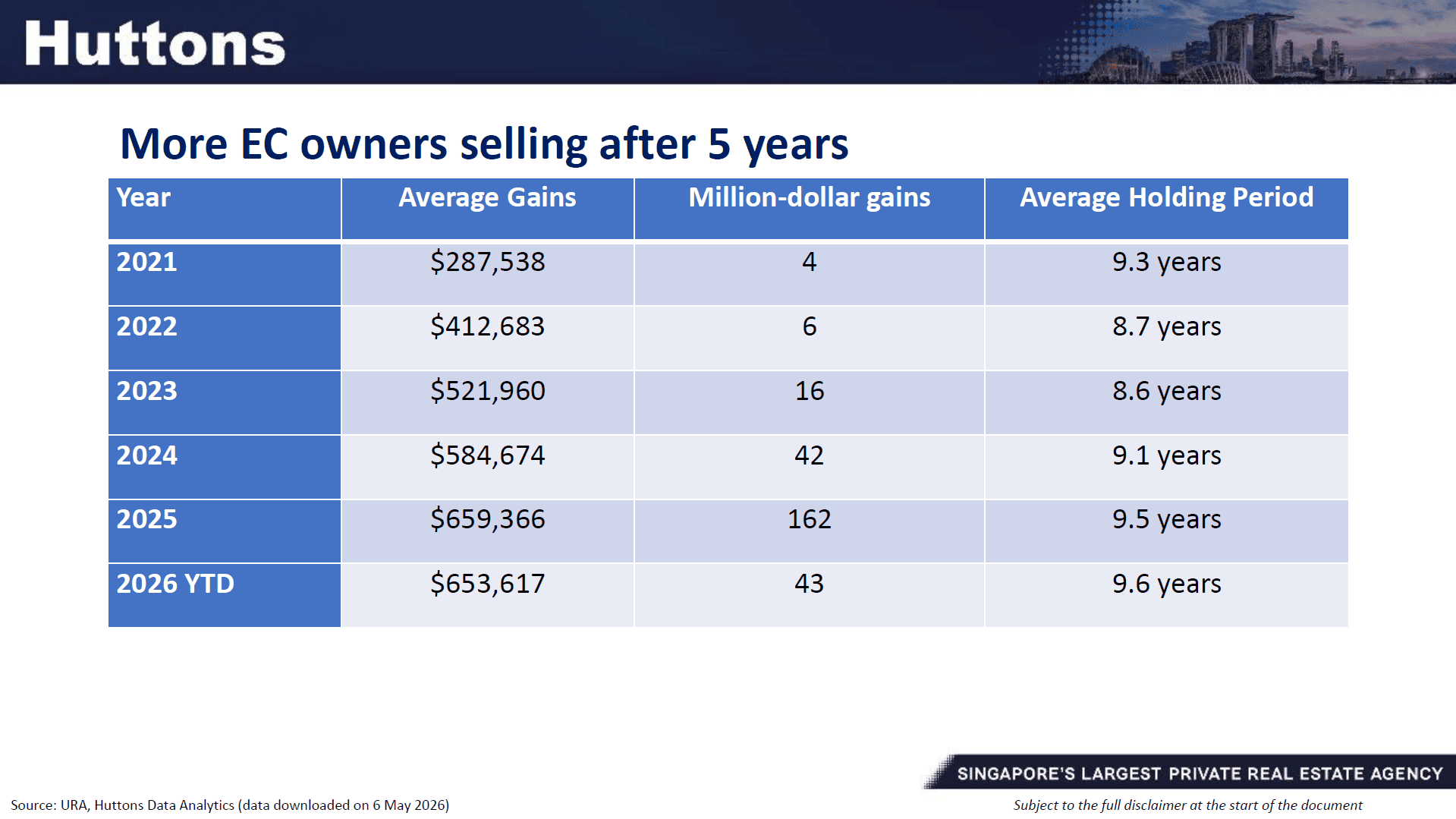
Between 2021 and 2025, roughly 75% of ECs transacted on the open market were sold within five years of their MOP, up from 45% in the preceding five-year period. Average EC resale gains escalated sharply: from S$287,538 in 2021 to a staggering S$659,366 in 2025. Million-dollar EC profit cases surged from just 4 in 2021 to 162 cases in 2025. In Q1 2026 alone, the top EC resale deals recorded gains of 130 to 140%, with sellers regularly pocketing over S$1 million in gross profit.
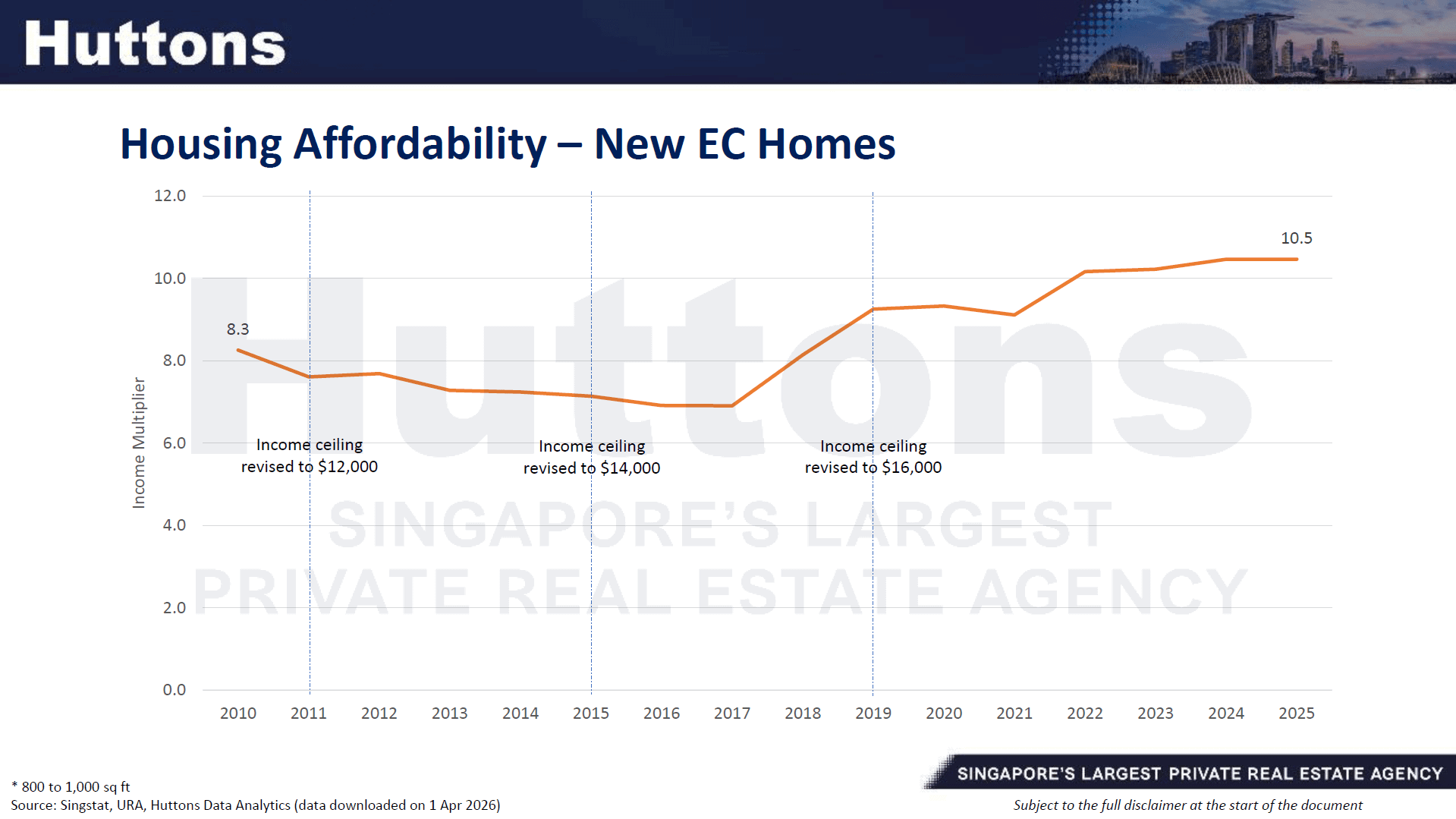
At the same time, new EC prices surged 120% from S$797 psf in 2015 to S$1,754 psf in 2025, more than double the 51% increase in median HDB resale prices over the same period. The income multiplier for new EC homes climbed from 8.3 in 2010 to 10.5 in 2025, even after successive income ceiling revisions.
The proportion of first-time EC buyers also quietly declined, from about 50% in 2020 to between 30% and 40% in 2024 and 2025. Second-timers, armed with larger CPF balances and cash proceeds from previous property sales, were increasingly crowding out first-timers at launches.
The final straw? Launches like Rivelle Tampines, which sold 92.5% of its 572 units at a record median of S$1,893 psf on launch weekend in March 2026, and was fully sold out within a month. And at Rivelle Tampines, an extraordinary 87.9% of buyers chose the Deferred Payment Scheme, suggesting that many were actively managing dual financial commitments. Coastal Cabana, which launched in January 2026, moved 498 of its 748 units at an average of S$1,734 psf on launch weekend.
ECs had become, for many, less of a home and more of an investment strategy with a five-year exit plan. The government saw this clearly, and responded.
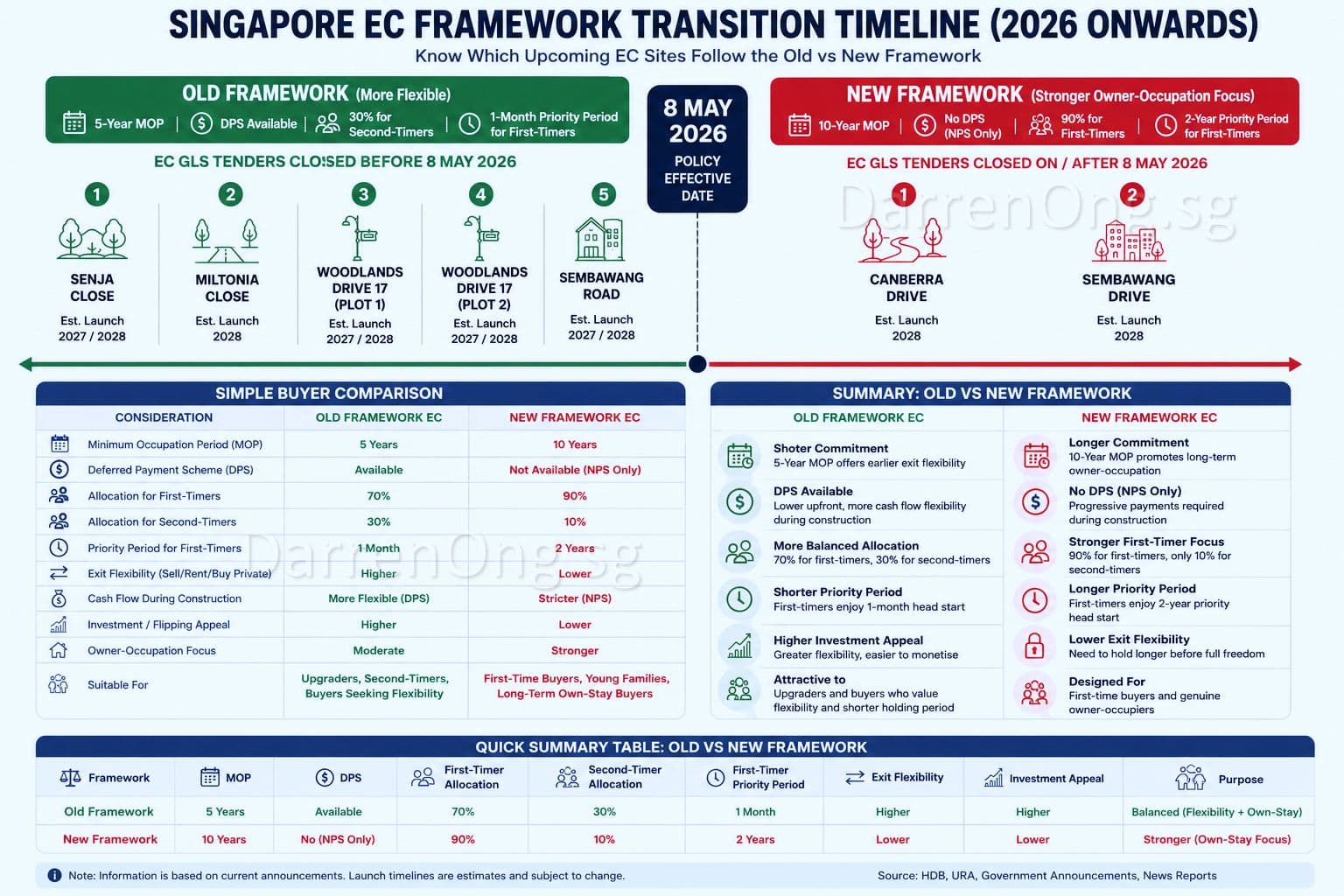
These changes apply to all EC projects on Government Land Sales (GLS) sites with tender closing dates on or after 8 May 2026. EC Projects already in the pipeline, such as the Senja Close site, Woodlands Drive 17 sites, the Sembawang Road site, and the Miltonia Close site, are not affected. The first two sites subject to the new rules are the Canberra Drive site (May 2026 tender) and the Sembawang Drive site (June 2026 tender).
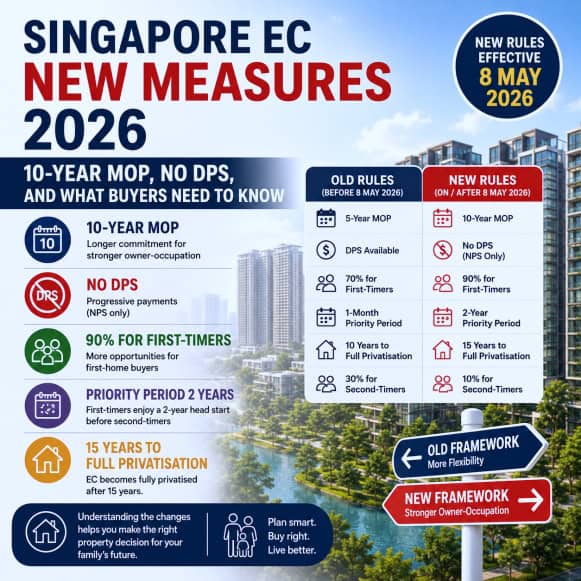
Here are the three changes:
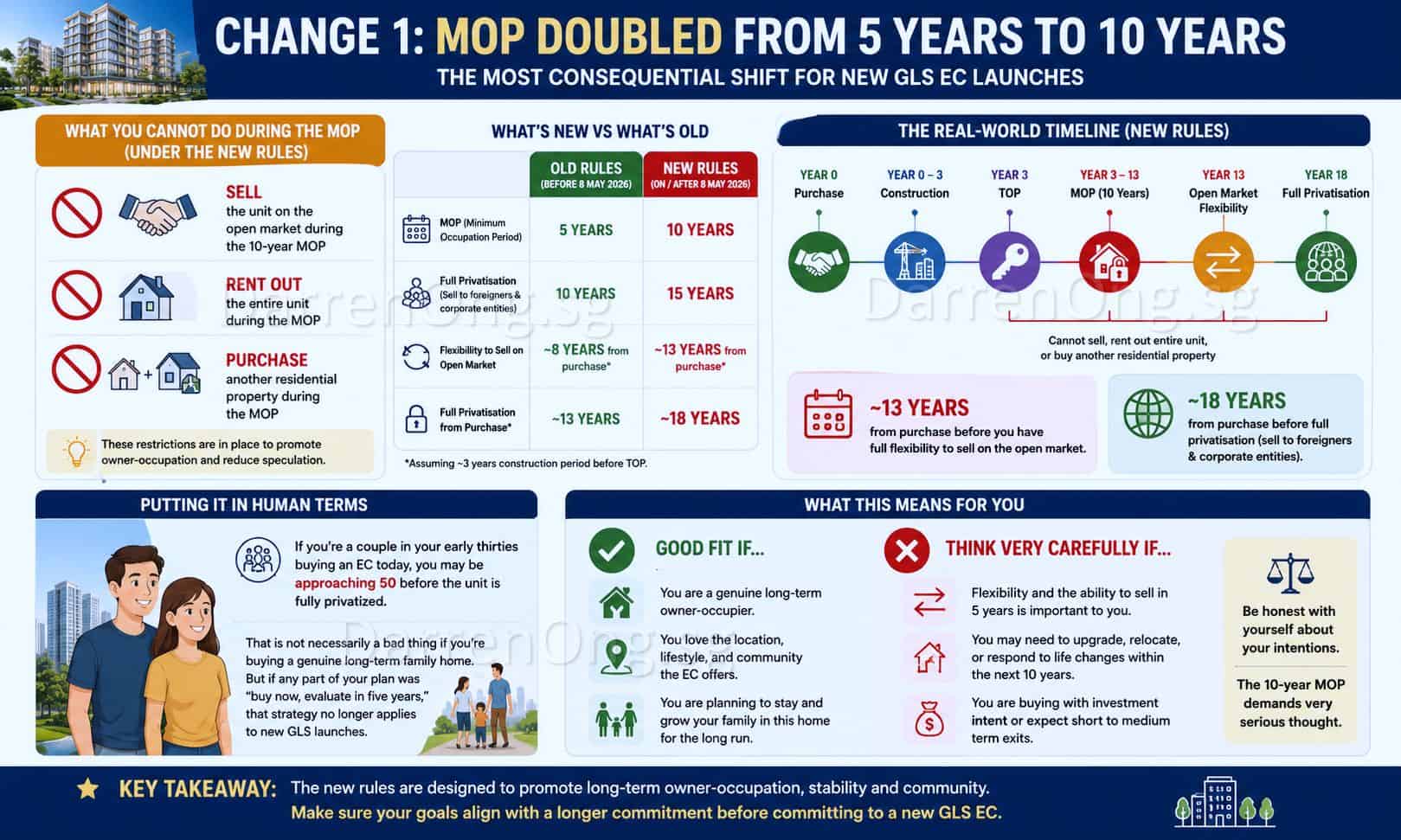
This is the most consequential shift.
Under the new rules, once you purchase an EC on a new GLS site, you cannot:
- Sell the unit on the open market during the 10-year MOP
- Rent out the entire unit during the MOP
- Purchase another residential property during the MOP
Full privatisation, meaning you can sell to foreigners and corporate entities, now only occurs after 15 years from TOP, up from the previous 10 years.
Here is the real-world timeline most people aren’t talking about openly. Factor in roughly three years of construction, and a buyer today is looking at approximately 13 years from purchase before they have full flexibility to sell on the open market, and 18 years before full privatisation.
To put that in human terms: if you’re a couple in your early thirties buying an EC today, you may be approaching 50 before the unit is fully privatized.
That is not necessarily a bad thing if you’re buying a genuine long-term family home. But if any part of your plan was “buy now, evaluate in five years,” that strategy no longer applies to new GLS launches.
What this means for you: Be honest with yourself about your intentions. If you’re a genuine long-term owner-occupier who loves the location and the lifestyle an EC offers, this may be a good fit. If flexibility and the ability to respond to life’s changes matter to you, the 10-year MOP demands very serious thought.
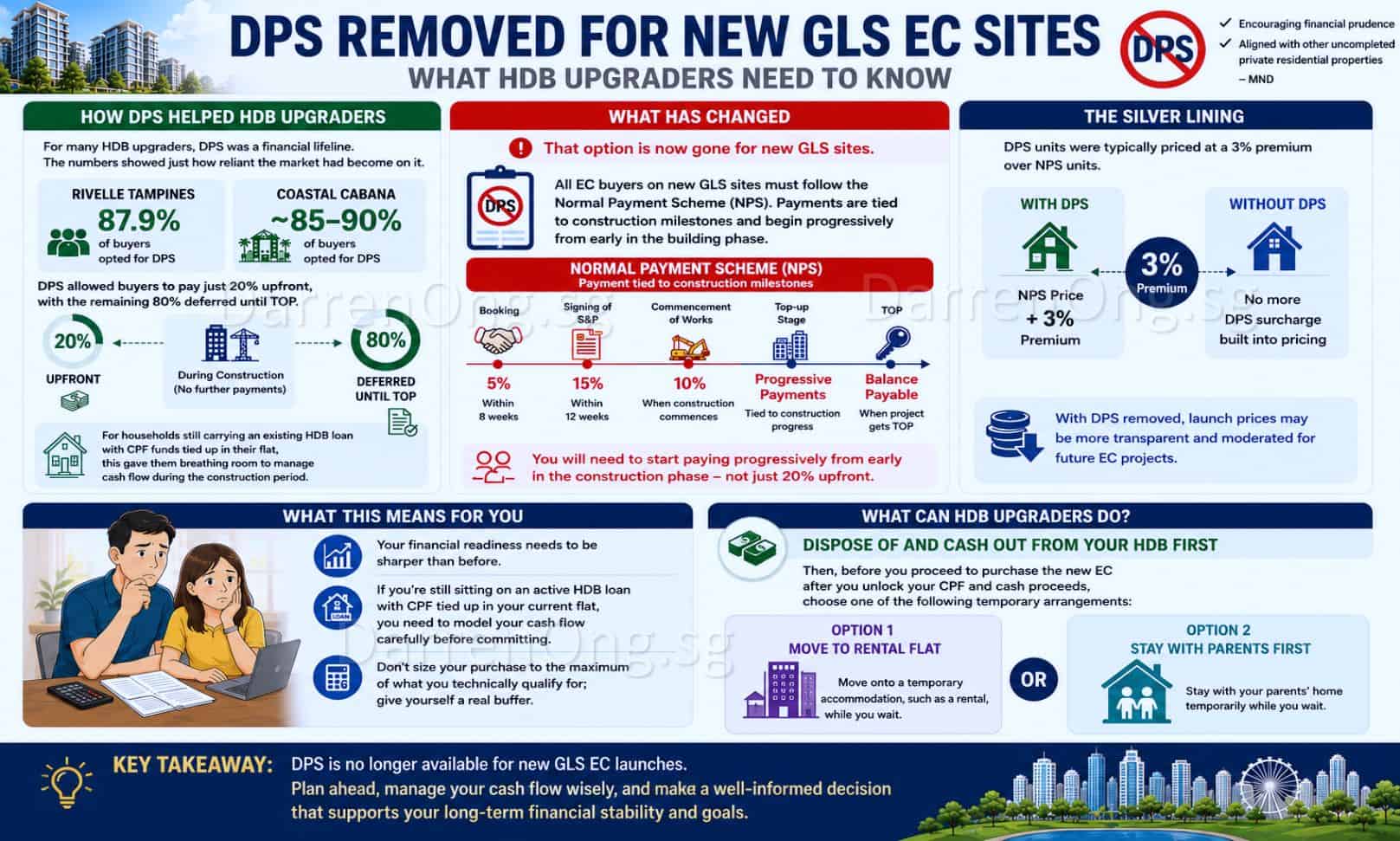
For many HDB upgraders, DPS was a financial lifeline, and the numbers showed just how reliant the market had become on it.
At Rivelle Tampines, 87.9% of buyers opted for DPS. At Coastal Cabana, the figure was similarly high. DPS allowed buyers to pay just 20% upfront, with the remaining 80% deferred until the project received its Temporary Occupation Permit (TOP). For households still carrying an existing HDB loan, with CPF funds tied up in their flat, this gave them breathing room to manage cash flow during the construction period.
That option is now gone for new GLS sites.
MND stated the removal was designed to “encourage financial prudence and to align with the arrangements for other uncompleted private residential properties.” Going forward, all EC buyers on new GLS sites must follow the Normal Payment Scheme (NPS), where payments are tied to construction milestones and begin progressively from early in the building phase.
There is one meaningful silver lining. DPS units were typically priced at a 3% premium over NPS units. With DPS removed, there is no longer a DPS surcharge built into pricing, which may result in slightly more transparent and moderated launch prices for future EC projects.
What this means for you: Your financial readiness needs to be sharper than before. If you’re still sitting on an active HDB loan with CPF tied up in your current flat, you need to model your cash flow carefully before committing to a new EC launch. Don’t size your purchase to the maximum of what you technically qualify for; give yourself a real buffer. Alternatively, you may choose to dispose of and cash out from your HDB first and move onto a temporary accommodation, such as a rental or your parents’ home, before you proceed to purchase the new EC after you unlock your CPF and cash proceeds.
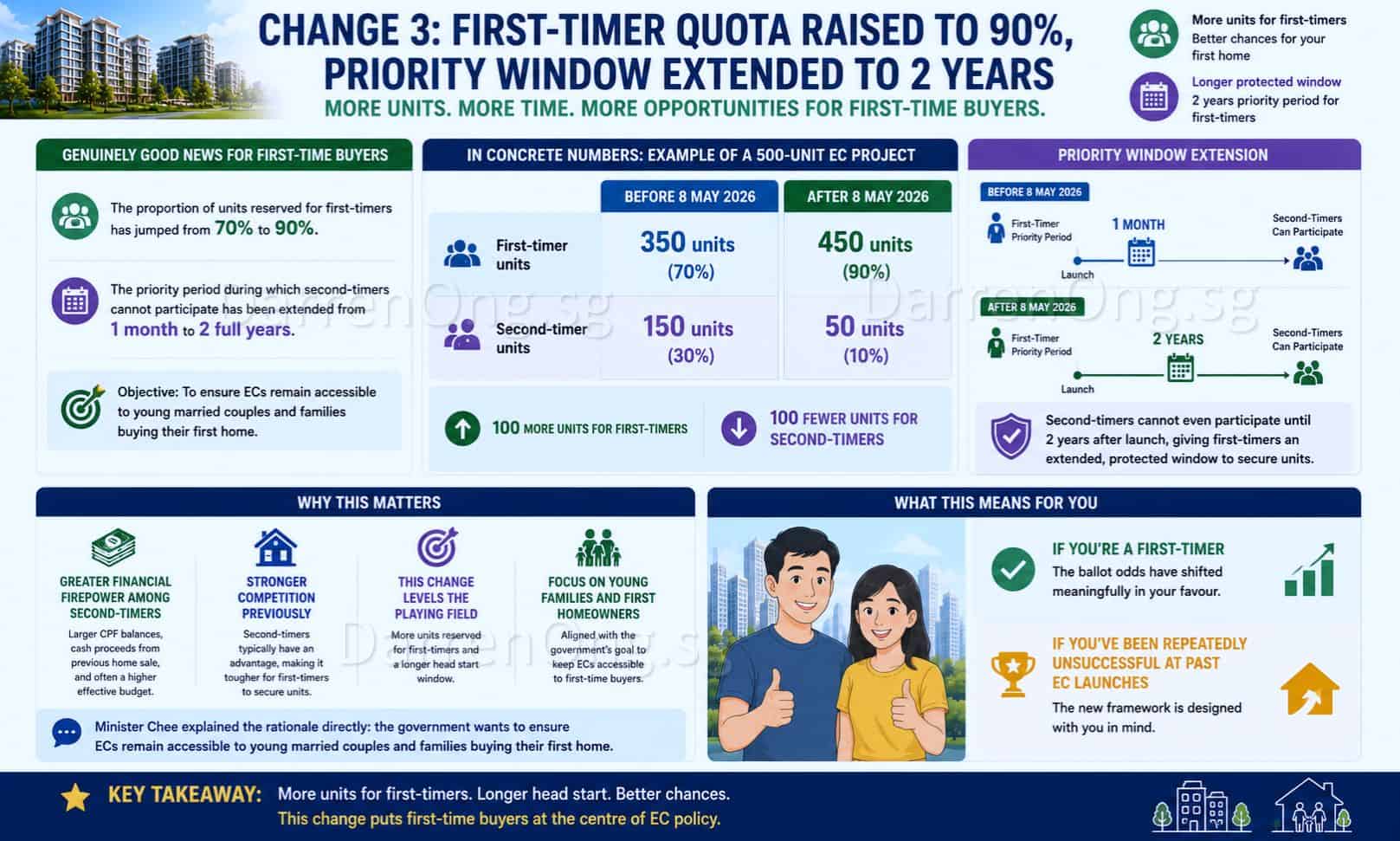
This is genuinely good news for first-time buyers, and it’s significant.
The proportion of units reserved for first-timers has jumped from 70% to 90%, and the priority period during which second-timers cannot participate has been extended from one month to two full years.
In concrete numbers, for example, a 500-unit EC project:
| Before 8 May 2026 | After 8 May 2026 | |
|---|---|---|
| First-timer units | 350 units (70%) | 450 units (90%) |
| Second-timer units | 150 units (30%) | 50 units (10%) |
That’s 100 more units for first-timers, and 100 fewer for second-timers who typically have far greater financial firepower, larger CPF balances, cash proceeds from their previous home sale, and often a higher effective budget.
Minister Chee explained the rationale directly: the government wants to ensure ECs remain accessible to young married couples and families buying their first home. The priority window extension means second-timers cannot even participate until two years after launch, giving first-timers an extended, protected window to secure units.
What this means for you: If you’re a first-timer, the ballot odds have shifted meaningfully in your favour. If you’ve been repeatedly unsuccessful at past EC launches, the new framework is designed with you in mind.
One of the most common questions I get is: “Given all this, should I just buy a private condo instead?”
It’s a fair question, and the answer depends on your numbers and your priorities.
Here’s how the two pathways compare for a household at the EC income ceiling of S$16,000 per month:
| Executive Condominium | Private Condominium (OCR) | |
|---|---|---|
| Loan framework | MSR 30% | TDSR 55% |
| Estimated purchase budget | ~S$1.6 million | ~S$2.45 million |
| CPF Housing Grant | Up to S$30,000 | Not applicable |
| MOP | 10 years (new launches) | None |
| Income ceiling | S$16,000/month | None |
| Median new launch psf (2026) | ~S$1,843 psf | ~S$2,278 psf |
The pricing gap between new ECs and comparable OCR private condos currently sits at roughly 21%, and that’s before factoring in CPF grants available to eligible EC first-timers.
For many middle-income families, the EC remains the most accessible and subsidized path into condo-style living. That value proposition doesn’t disappear with the new rules. What changes is the commitment you’re making, and for how long.
However, private condos do offer meaningful advantages that are worth acknowledging honestly. There is no MOP restriction, no income ceiling, no restriction on renting out the unit, and your buyer pool when you eventually sell is completely open, including foreigners and corporate buyers. With an OCR private condo, you’re not locked in for 13 years. If your family’s circumstances change, a new job, a growing family, a market opportunity, you retain full flexibility to respond.
The honest take: An EC is the right choice if you’re a genuine long-term owner-occupier who values the affordability, the CPF grant, and the condo lifestyle, and you’re clear about staying in the property for the long haul. A private condo may be worth stretching your budget for if flexibility, exit optionality, and a wider resale market matter significantly to you.
Here is the data-driven answer: probably not dramatically, but the direction of price growth should moderate.
The developers will need to be more cautious in their land bids going forward, as the new restrictions could affect take-up rates, financing conditions, and first-time buyers’ purchasing power. Over time, this could place some downward pressure on EC land bids and launch pricing for affected sites. The future affected EC projects could see prices corrected by around a few percent from current median launch prices, assuming no other major changes, such as an EC income ceiling revision.
This moderation in land bids is already being anticipated for the first two affected sites. Canberra Drive (May 2026 tender, 185 units) and Sembawang Drive (June 2026 tender, 450 units) will be the first real test of how developers reprice their bids under the new framework.
That said, a structural floor on EC prices remains intact for several reasons. Construction and land costs remain elevated across the board. Private condo prices in the OCR continue to trend upward. As long as the private condo prices remain significantly higher than ECs, that pricing gap continues to underpin EC demand.
The bottom line: expect EC price growth to slow and launch momentum to become more selective. But don’t expect a sharp collapse back to historical price levels. Those days are unlikely to return.
This is where some of the most immediate opportunities lie, and it’s a point that deserves direct attention.
Several EC GLS sites tendered before 8 May 2026 still operate entirely under the old framework: 5-year MOP, DPS availability, 30% second-timer allocation, and greater exit flexibility. These include:
- Senja Close EC Site — 295-306 units, estimated above S$1,800 psf
- Woodlands Drive 17 EC Site (Plor 1) — 420-430 units, estimated above S$1,800 psf
- Woodlands Drive 17 EC Site (Plot 2) — 560 units, estimated above S$1,900 psf
- Sembawang Road EC Site — 265 units, estimated above S$1,700 psf
- Miltonia Close EC Site — 430 units, estimated above S$1,800 psf
These five projects now occupy a uniquely attractive position in the market. Buyers who want the original EC benefits, a shorter holding period, DPS flexibility, a meaningful second-timer allocation, and faster exit potential, will find these projects represent the last opportunity to buy under the old rules.
Analysts have highlighted that this “last batch” dynamic could create concentrated demand at these launches. Buyers who were undecided may now feel urgency. Second-timers locked out of new-framework launches for two years will also have strong incentive to act quickly on these projects.
If you’ve been watching any of these upcoming launches, this context matters. The combination of old-framework benefits and a market that now clearly understands what the alternative looks like is likely to be a meaningful catalyst for demand.
Second-timers are arguably the group most significantly affected by the new measures.
Under the new rules, only 10% of units in a new-framework EC project are set aside for second-timers, down from 30% previously. They won’t be able to access those units until two years after the project launches. In a 500-unit EC, that’s just 50 units available at launch, and once the quota is reached, second-timers can only re-enter after a two-year wait.
For most second-timers, new-framework EC launches are simply no longer a realistic primary pathway.
Where might displaced upgrader demand flow?
Old-framework EC launches (listed above) still offer 30% second-timer allocation and remain under the 5-year MOP. These are the most direct alternative for second-timers who still want an EC experience.
Resale EC market — No eligibility restrictions on buyers, no MOP concerns, and a broader range of locations and sizes. With the supply of resale ECs potentially receiving a boost in interest from displaced second-timer demand, this segment bears watching.
OCR private condominiums — The natural next step for second-timers who need flexibility and have a strong enough budget. Current median OCR new launch prices sit around S$2,278 psf, meaningfully higher than ECs, but with no MOP, no income ceiling, and a fully open buyer pool at exit.
The key question for every second-timer isn’t just affordability. It’s which pathway gives me the right combination of value, flexibility, and long-term fit for where my family is going?
Numbers are one thing. Let’s put this in reallife terms.
Imagine a couple, let’s call them Paul and Sarah. Paul is 35 years old and Sarah is 32 years old. They buy a new-framework EC in 2027. Construction takes three years. They move in around 2030. The 10-year MOP begins from TOP.
By the time they can sell freely on the open market, it will be 2040. Paul would be 48, and Sarah would be 44. By the time full privatization occurs and they can sell to any buyer including foreigners, it’s 2045, which end up to be 53 and 49.
During those 13 to 18 years, their family may grow, their parents may need support, and their careers may take them in unexpected directions. They cannot upgrade. They cannot monetize their gains early. They cannot easily respond to a favourable market window.
None of this makes buying a new-framework EC the wrong decision. For a couple genuinely committed to a long-term family home in a location they love, at a price point that gives them financial breathing room versus a private condo, it could be exactly right.
But it does mean the decision deserves more than just a comparison of psf prices and monthly installments. It requires honest clarity about what the next 13 years of your life might look like. Thus, I would suggest Paul and Sarah jump onto a longer-term plan, in terms of financials, family size, and maybe also parents’ support plan, if they are buying the new framework EC.
If you’re a first-timer: The new measures are broadly in your favour. Better ballot odds, a longer protected window, and a framework clearly designed with you in mind. The question is whether you’re genuinely comfortable committing to a long-term owner-occupied home, and whether the location and unit type suit your family’s real needs for the long haul.
If you’re a second-timer looking at new launches: The math has changed significantly. Weigh the limited 10% allocation, the two-year wait, the longer MOP, and the removal of DPS against what the old-framework EC launches or OCR private condos can offer you. Don’t default to “I’ll just go for the EC” without running the numbers properly.
If you’re watching the last batch of old-framework ECs: These may represent a genuinely time-limited window. The combination of 5-year MOP, DPS availability, and 30% second-timer access is not coming back for new GLS sites. If any of these projects suit your location and budget needs, understand the context of what you’re looking at.
If you already own an EC: Your property is not affected by these new rules. And there’s a reasonable case that reduced future supply of flexible-framework ECs entering the market, combined with displaced second-timer demand flowing into the resale segment, may indirectly support resale EC values over time.
The new EC measures aren’t inherently good or bad. They’re a structural reset, one that returns ECs closer to their original purpose while creating a more complex decision-making landscape for buyers.
What I’ve seen time and again is that the buyers who make the best property decisions aren’t the ones who know the most about the market. They’re the ones who are clearest about what they actually need, for their family, their finances, and their life plan over the next decade and beyond.
Whether you’re weighing a new-framework EC against an old-framework launch, comparing an EC to an OCR private condo, or simply trying to understand what these changes mean for your existing property, the most valuable thing you can do is sit down with someone who can look at your specific situation clearly and honestly.
If that sounds like a conversation worth having, I’d be glad to connect. No pressure, no hard sell. Just a focused discussion around your numbers, your priorities, and which pathway makes the most sense for where your family is actually going.
Drop me a message and let’s talk.
Whether you’re just beginning to explore or already close to a decision, getting clarity before you commit to a 10-to-13-year journey is always worth the time.
Need Real Estate Consultation?
Contact Me
Feel free to connect with me!
Group District Director
Huttons Asia Pte Ltd
CEA Registration No.: R026434F
Agency License: L3008899K
Contact: 93839588

Singapore EC New Measures 2026: What Every Buyer Needs to Know Before Making Their Next Move
Singapore’s EC rules changed on 8 May 2026 — 10-year MOP, no Deferred Payment Scheme, a higher first-timer quota, and a long first-timer priority period. Here’s what it really means for your next property move.

Where Can You Find and How to Buy an Upcoming Executive Condominium (EC) in 2026
Updated with New EC Rules 2026
. Buying Exec Condo EC Guides 2026. Rivelle at Tampines EC, Coastal Cabana EC at Pasir Ris. Other Upcoming New Launch EC include Senja Close, Woodlands Dr 17 and Sembwang Road site. Purchase Procedures Guides Available. Connect for more info now.

Singapore New Launch Condos 2026: Where the Next Property Opportunities Are Emerging
Discover Singapore new condo launches in 2026, upcoming projects, supply trends and property market outlook to help buyers and investors make informed decisions.

Selling Your Condo in Singapore 2026: Step-by-Step Guide & What to Know Before You Start
Selling your condo soon? Learn how to sell a condo in Singapore with confidence — from staging and pricing to picking a trusted property agent. Avoid costly mistakes and discover tips that help you sell faster and smarter.

How Property Loan Strategies Help Singapore Investors Improve Cash Flow and ROI Through Smart Leverage
Learn how property loans and leverage help Singapore investors improve cash flow, boost ROI, and build long-term wealth with smarter financing strategies.

Understand Property Wealth Planning
Ever heard of the term ‘Property Wealth Planning’ (PWP) and wondered what it means? Well, you’re not alone. Let’s dive in and understand the strategy.