
Your Next Property Move: The 5 Decisions That Shape Your Property Wealth Journey in Singapore

Your Next Property Move: The 5 Decisions That Shape Your Property Wealth Journey in Singapore
16 min read

Table of Contents

Your Next Property Move: The 5 Decisions That Shape Your Property Wealth Journey in Singapore

Property decisions rarely begin with numbers alone. They often begin with a change in life: the kids need more space, the commute feels too long, an HDB owner starts wondering if their equity can support the next move.

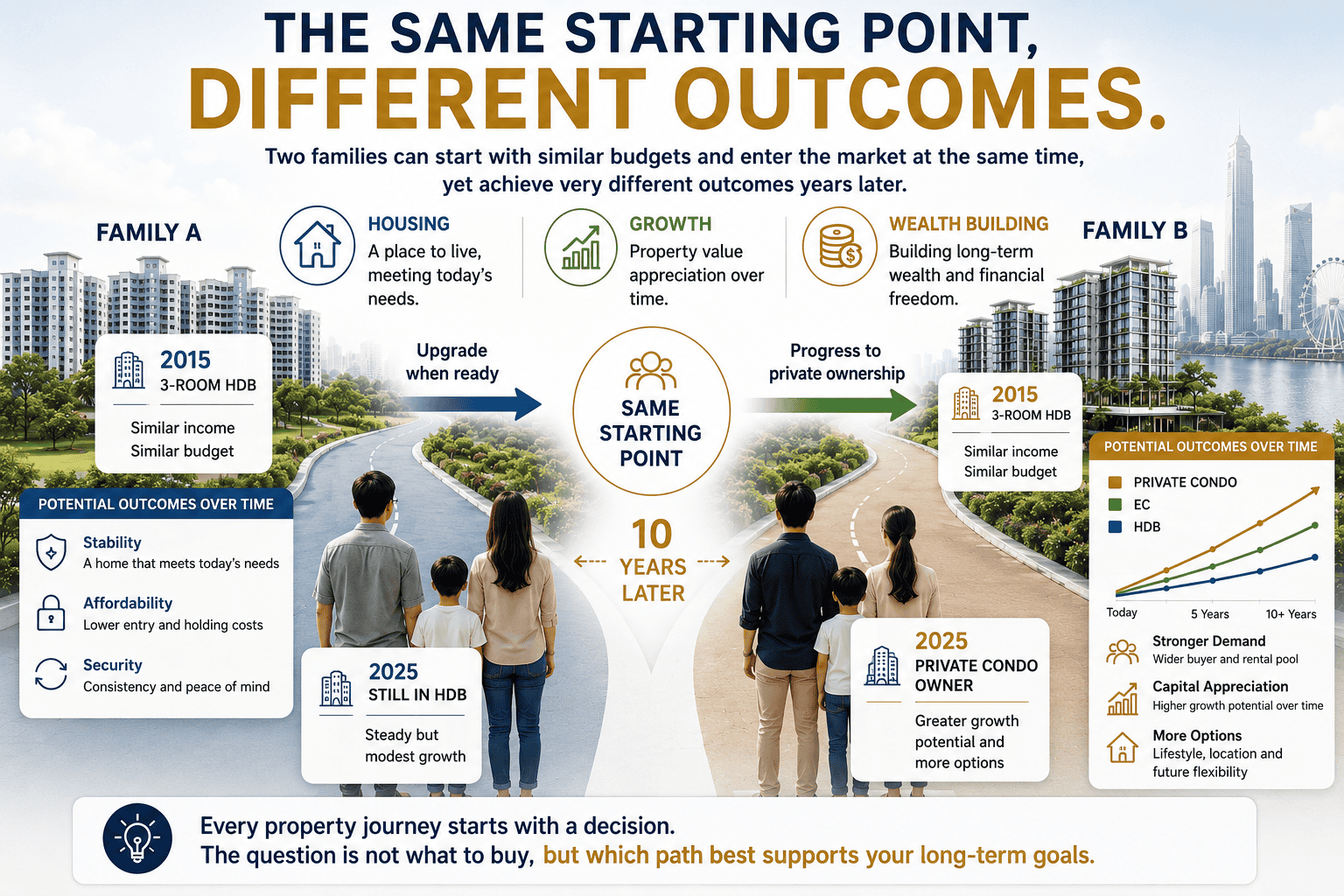
Two households can start from similar positions, with the same flat type, comparable income, and similar CPF savings, and end up in very different places ten years later. One stays put and builds stability. Another progresses smoothly to an EC or private property. A third upgrades too aggressively and finds the mortgage crowding out everything else.

The property type purchased doesn’t decide the outcome. The decisions made before the purchase do.

A condominium doesn’t automatically create wealth. A new launch doesn’t necessarily outperform a resale. Waiting isn’t always safer, and acting fast isn’t always wiser. The real question is: Does this property decision improve your overall position?

This article covers five decisions that shape a Singapore homeowner’s property journey:

  1. Are you buying a home or building wealth?
  2. Is your next step too big or too small?
  3. Buy new or buy what’s already built?
  4. How do you separate a good property from a good investment?
  5. What is the real cost of waiting?

These aren’t meant to produce one universal answer. A young couple’s strategy won’t suit an HDB upgrader with school-going kids, and a household nearing retirement may value lower debt over capital growth. The goal isn’t to tell you what to buy. It’s to help you ask better questions before your next move.

The same starting point, different outcomes - Singapore property journey_i2V2

Decision 1: Are You Buying a Home or Building Wealth?

Every property should work as a home first: a suitable layout, a practical location, somewhere the household can live comfortably. But it’s also likely one of the family’s largest financial assets, and that creates tension, since the home that best fits your lifestyle today may not be the strongest choice for long-term asset progression. The goal isn’t lifestyle vs wealth; it’s understanding what role your next property needs to play.

The Dilemma

Picture two units: one beautifully renovated with a home-like feel, the other more ordinary but with a more efficient layout, better connectivity, and a more competitive price. Most families are drawn to the first, and that’s a natural response; people experience a home through space and comfort, not spreadsheets.

But future buyers may see it differently. They’re unlikely to pay for the original cost of your renovation; they’ll care more about layout, price, transport access and alternatives. A home is judged by how well it serves you now. An investment is also judged by how the market will value it later.

Where Buyers Go Wrong, and What to Check Instead

  • Buying mainly through emotion. Enjoying your home isn’t the risk; the risk is emotional attachment causing you to overlook an excessive entry price, an inefficient layout, weak future demand, or heavy competing supply. A property can feel perfect at viewing and still be bought at the wrong price.
  • Overvaluing renovation. It improves your experience today, but it depreciates: design preferences change, materials age, built-ins that suit you won’t suit the next buyer. What holds value over time: location, layout, facing, connectivity, price, and future marketability.
  • Focusing only on today’s lifestyle needs. Buying because it’s near your current workplace, or because the unit is larger, are valid reasons, but jobs move, and an oversized unit can carry a total price that narrows your future buyer pool. The better question: will this property work for us today, and still appeal to enough buyers when we sell?

What the Data Shows

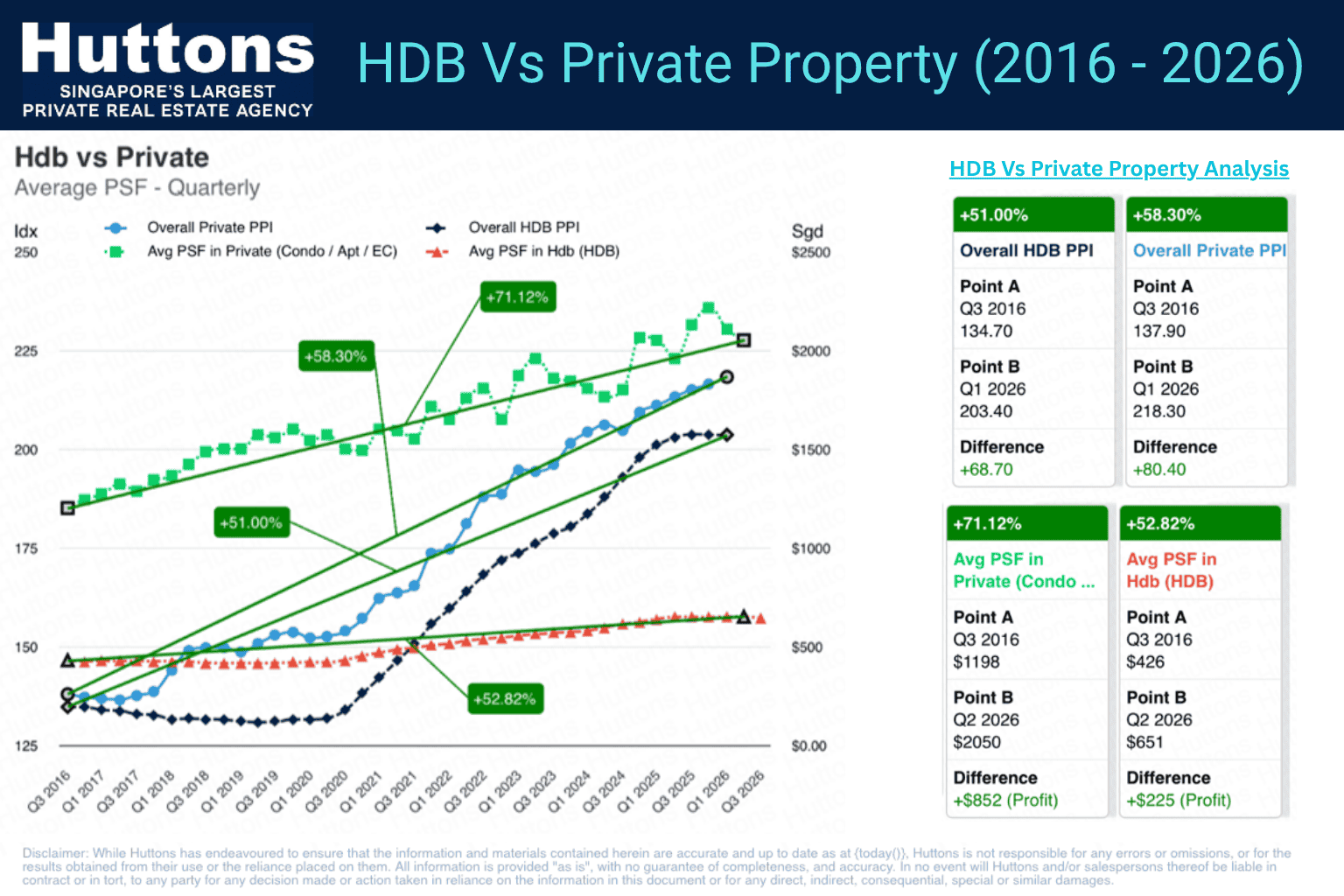
Both HDB flats and private residential properties saw meaningful growth over Q3 2016 to Q2 2026.

HDB Vs Private Property 2016-2026
Market measureStarting pointLatest pointGrowth
HDB Price Index134.7203.451.0%
Private Property Price Index137.9218.358.3%
Average HDB price psf$426$65152.82%
Average private property price psf$1,198$2,05071.12%

This doesn’t mean HDB is a poor asset, or that every private property outperforms. Private property grew faster on average, but an expensive condo bought at the wrong price can still underperform a well-located HDB bought sensibly. Category alone doesn’t decide the outcome; the project, unit, entry price and future demand do.

Before You Choose, Assess

  • Immediate needs vs preferences: bedrooms, proximity to family/schools, WFH space, ageing needs. Separate what’s essential from what’s nice-to-have.
  • The property’s financial role: housing stability, lifestyle improvement, wealth accumulation, or a balance. This determines how much debt is appropriate.
  • Entry price: benchmarked against similar transactions in the project, nearby developments, and comparable price-range alternatives.
  • Future buyer demand: would this appeal to upgraders, families, professionals nearby, right-sizers, or investors? A clear buyer profile strengthens resale.
  • Financial flexibility after purchase: what’s left for emergencies, retirement, and higher-rate scenarios once the purchase is done. Loan approval isn’t the same as genuine affordability.

Ask Yourself

  1. What must this property provide for my family today?
  2. What financial role should it play over the next ten years?
  3. Will future buyers value what I value now?

Key Insight: The best home for your family isn’t always the best property for your wealth journey. The strongest decision balances both, meeting genuine needs while retaining qualities future buyers will pay for.

Decision 2: Is Your Next Step Too Big or Too Small?

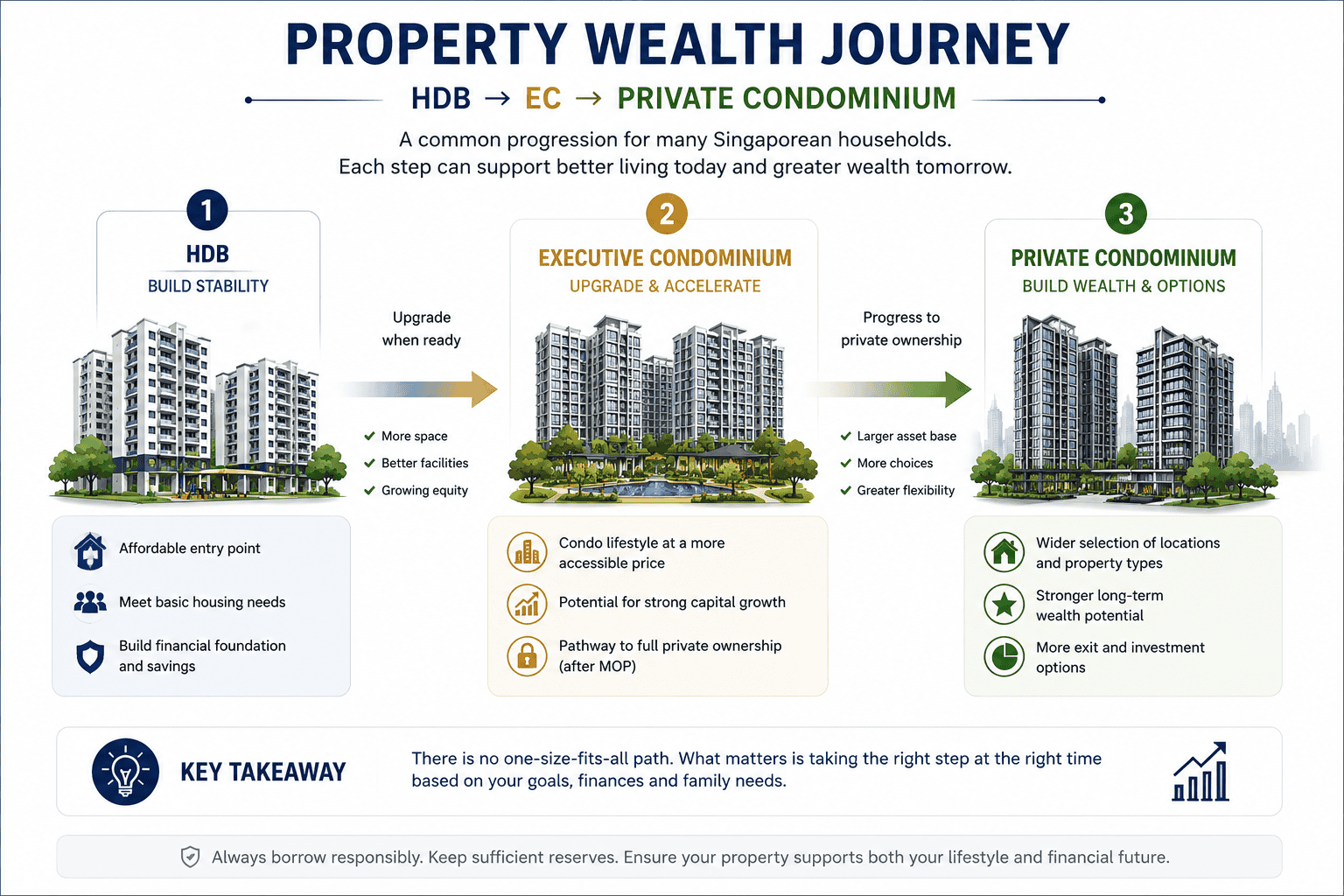
Once you know what role the property should play, the next question is how far to move. For most HDB owners, the choices look like: stay put, upgrade to an EC, or move directly into private property. The biggest step can look like the fastest progress, but a successful move improves your overall position without creating unnecessary pressure. Too small a step may not meet changing needs; too large a step may cost you flexibility. The right move is the one you can sustain comfortably while keeping future options open.

The Dilemma

An HDB family has cleared their MOP, income has grown, some of the loan is repaid, and they’ve built savings and CPF. The kids need more space and the family wants condo facilities. They’re ready to upgrade, but each path trades off differently.

Property Wealth Journey HDB to EC to Private Condominium

Staying put means lower monthly commitments, more savings for retirement, less rate exposure, and more flexibility if income changes, which is good for a household that values stability or would otherwise be stretched. The cost: the flat may no longer fit, and the price gap to your target property may widen over time.

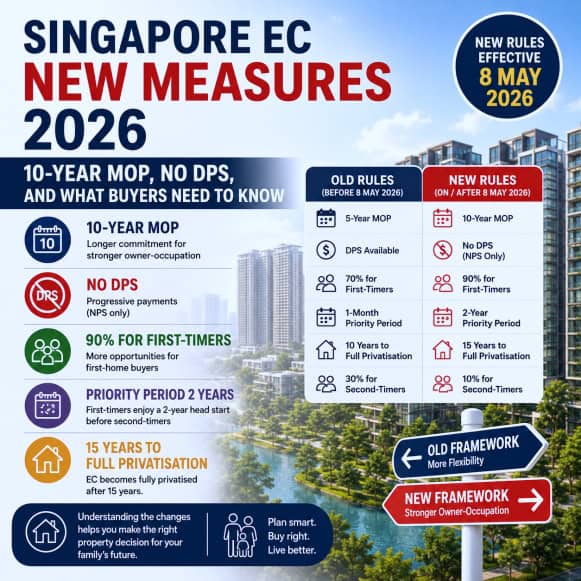
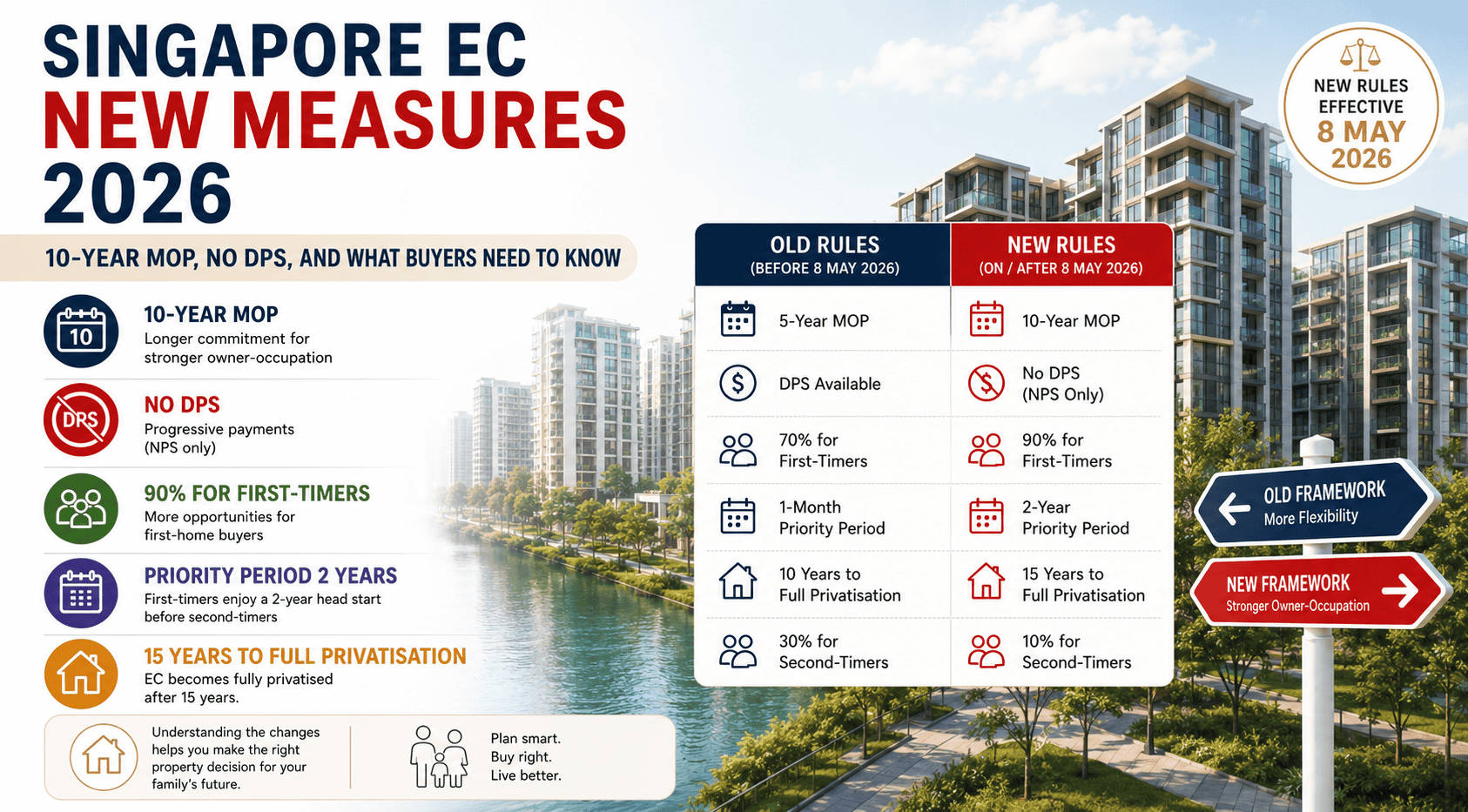
Upgrading to an EC offers condo facilities and a bigger asset base at a lower entry price than most private options: a lifestyle upgrade and a possible pathway to future private ownership for eligible households. But EC projects with land sale from 8 May 2026 carry longer holding requirements and later privatization, so treat it as a longer-term commitment (more on this below).

Moving directly into private property gives you more locations, more ownership flexibility, and a broader resale/rental market, but it demands a larger downpayment, mortgage, and reserve. If the purchase uses up nearly all available funds, there’s little left for renovation, emergencies, or life changes. The real question isn’t whether you can buy it; it’s whether you can keep holding it comfortably.

Where Buyers Go Wrong

  • Treating the maximum loan as the budget. A bank’s approved amount reflects lending limits, not your comfortable spending ceiling. Living expenses, insurance, retirement, renovation, and income disruption all still need to be funded from what’s left.
  • Assuming a bigger asset always means more wealth. A pricier property may offer more upside, but also more debt and holding cost. What actually determines wealth: outstanding loan, interest paid, CPF used, transaction and maintenance costs, and net proceeds after sale, not just the sticker price.
  • Underestimating flexibility. Life changes during a long holding period: moving for work, accommodating parents, growing families, career transitions, slow markets. The more financial flexibility you retain, the more of these you can handle without being forced into a bad decision.

Why ECs Became Popular, and How the Rules Are Changing

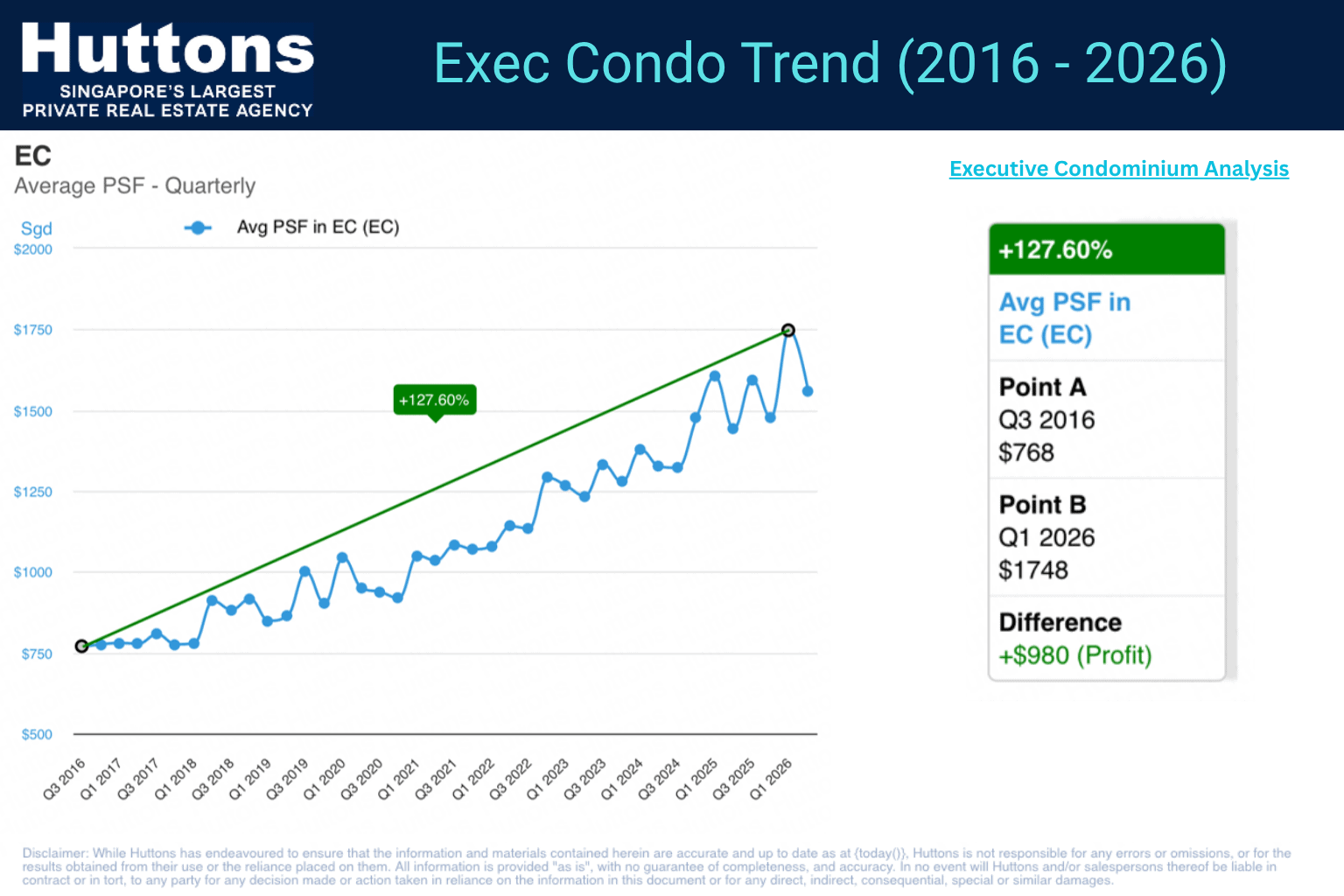
The traditional path, HDB to EC to private condo, worked because an EC sits between public and private housing: developer-built, condo facilities, but with eligibility and ownership conditions attached. Based on the past 10 years’ data, average EC prices rose from about $768 psf in Q3 2016 to $1,748 psf in Q1 2026, an increase of roughly 127.6%.

EC TREND 2016-2026
EC TREND 2016-2026

That doesn’t mean every EC will repeat this; performance still depends on entry price, location, unit, competing supply, demand, and holding period. The lesson isn’t that ECs always outperform, but that a well-selected EC at a sensible price can be an effective stepping stone.

That said, for newer EC projects from land sales after 8 May 2026, the longer MOP and later full privatization change the calculus. A buyer may need to stay through a much longer stage of family life: kids becoming teens, caregiving needs, changing work locations. The unit should be chosen as a long-term home first, not just for what’s affordable today, with more weight on layout suitability, location, financial reserves, and entry price.

New EC 2026 Rules
New EC 2026 Rules

Before You Move, Assess

  • Existing equity and available funds: what remains after outstanding loan, CPF refund, and selling/legal costs, not the headline selling price.
  • Comfortable monthly commitment: stress-tested against a higher rate, one lost income, or a longer-than-expected holding period.
  • Long-term suitability: will the unit still work as kids grow, parents move in, or accessibility needs increase? This matters more with a long occupation requirement.
  • Options preserved after purchase: can you still hold through a weak market, upgrade later, right-size, or keep emergency savings intact?

Ask Yourself

  1. Can we hold this comfortably without everything going perfectly?
  2. Will the home stay suitable through the expected holding period?
  3. Does this move create more future options, or reduce them?

Key Insight: The fastest route isn’t always the safest one. The goal isn’t a more expensive property; it’s a stronger position.

Decision 3: Is It Better to Buy New or Buy What's Already Built?

New launch or resale is one of the most common questions in the Singapore market. A new launch offers a brand-new home, modern facilities and progressive payments. A resale offers certainty, immediate occupation, and often more usable space for the same budget. Both can be good purchases, and both can be poor investments. The mistake is assuming one category is always superior. The real comparison isn’t new vs resale; it’s: which property gives you the stronger position at the price you’re paying?

The Dilemma

The new launch pull. Modern architecture, fresh facilities, new fittings, smart-home features, longer remaining leases, progressive payments during construction. Showflats are designed to create emotional pull, and that’s understandable for owner-occupiers and investors alike. But newness alone doesn’t create value: a compact, inefficient layout stays inefficient, and a high entry price stays high regardless of how new the building is.

The resale advantage. Less exciting, but you can inspect the actual unit, real view, natural light, noise, and true travel time, and you get immediate occupation, possible immediate rental income, larger internal areas, and a proven transaction history. The trade-off: older facilities, a shorter remaining lease, and higher upfront repair or renovation costs.

Where Buyers Go Wrong

  • Assuming newer automatically means better. Still check layout efficiency, price, facing, competing supply, and the premium over nearby resale. The premium for newness has to be justified by fundamentals, not just paint and marketing.
  • Comparing only PSF. A lower PSF doesn’t mean better value if the space is eaten up by long corridors and awkward corners. Compare total price, usable space, and layout efficiency instead.
  • Fixating on the initial progressive instalment. During construction, new-launch buyers only service the amounts progressively disbursed, a genuine short-term cash-flow advantage. But once TOP hits and the full loan is drawn, the real mortgage begins. Assess the completed instalment, not just the low starting payment.

Progressive Payment vs Immediate Use

New launch: lower initial instalments, more time to save and prepare, but no immediate occupation or rental income, and some unit attributes can only be estimated pre-completion.

Resale: immediate use and possible immediate rental income, and you know exactly what you’re getting, but the full mortgage starts immediately, and renovation or repair needs may surface sooner.

The right choice partly comes down to whether you value short-term cash preservation or immediate use and income.

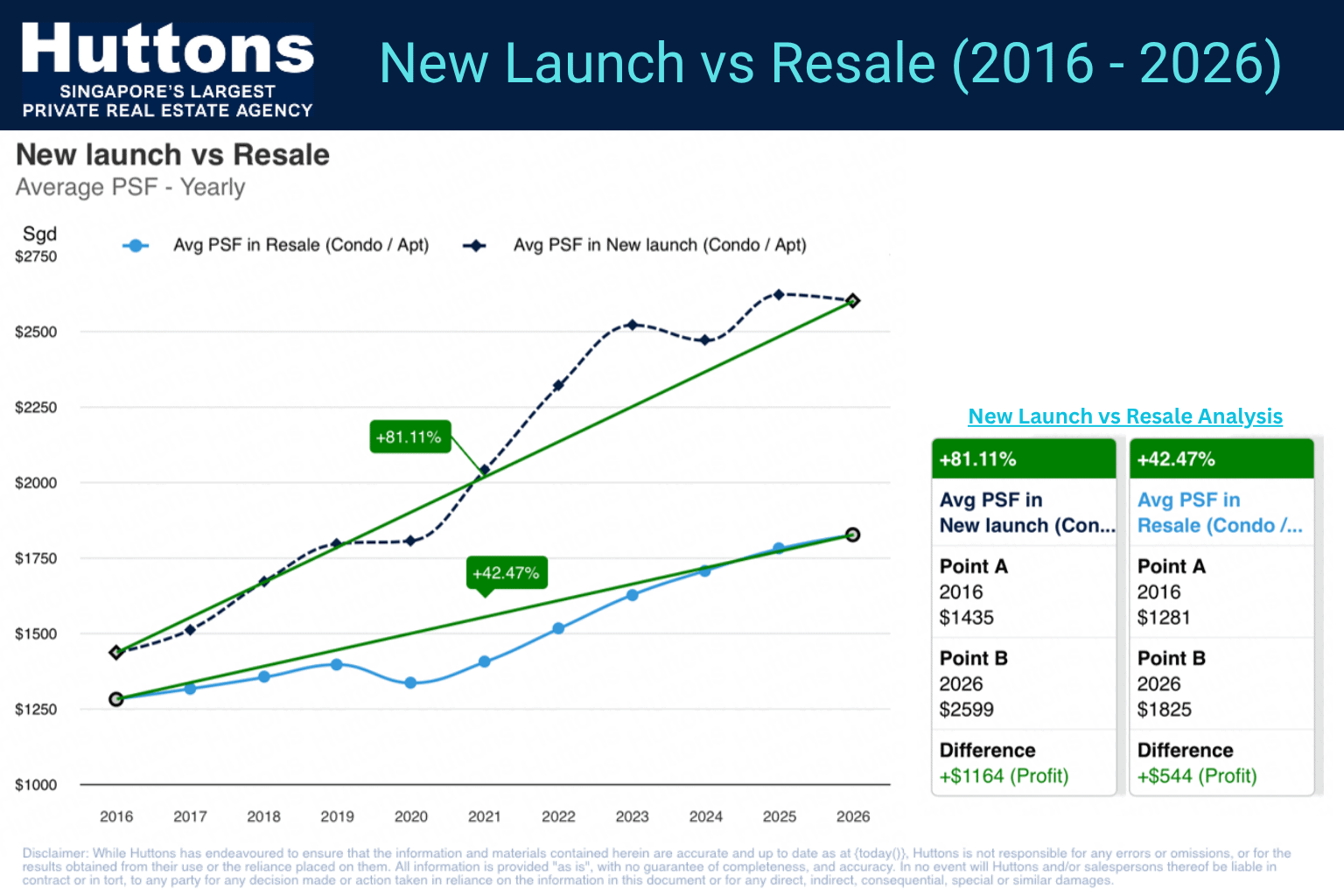
What the Data Shows (2016 to 2026)

New Launch vs Resale 2016-2026
Market segmentStarting avg PSFLatest avg PSFGrowth
New launch$1,435$2,59981.11%
Resale$1,281$1,82542.47%

New launches grew faster on average, but that doesn’t mean every new-launch buyer beat every resale buyer. Outcomes still depend on project, launch phase, entry price, unit type, and eventual selling price. An early buyer in a well-positioned launch can benefit from later price increases in the same project; a resale bought below market value can still outperform an overpriced new launch. Timing and price position matter more than category.

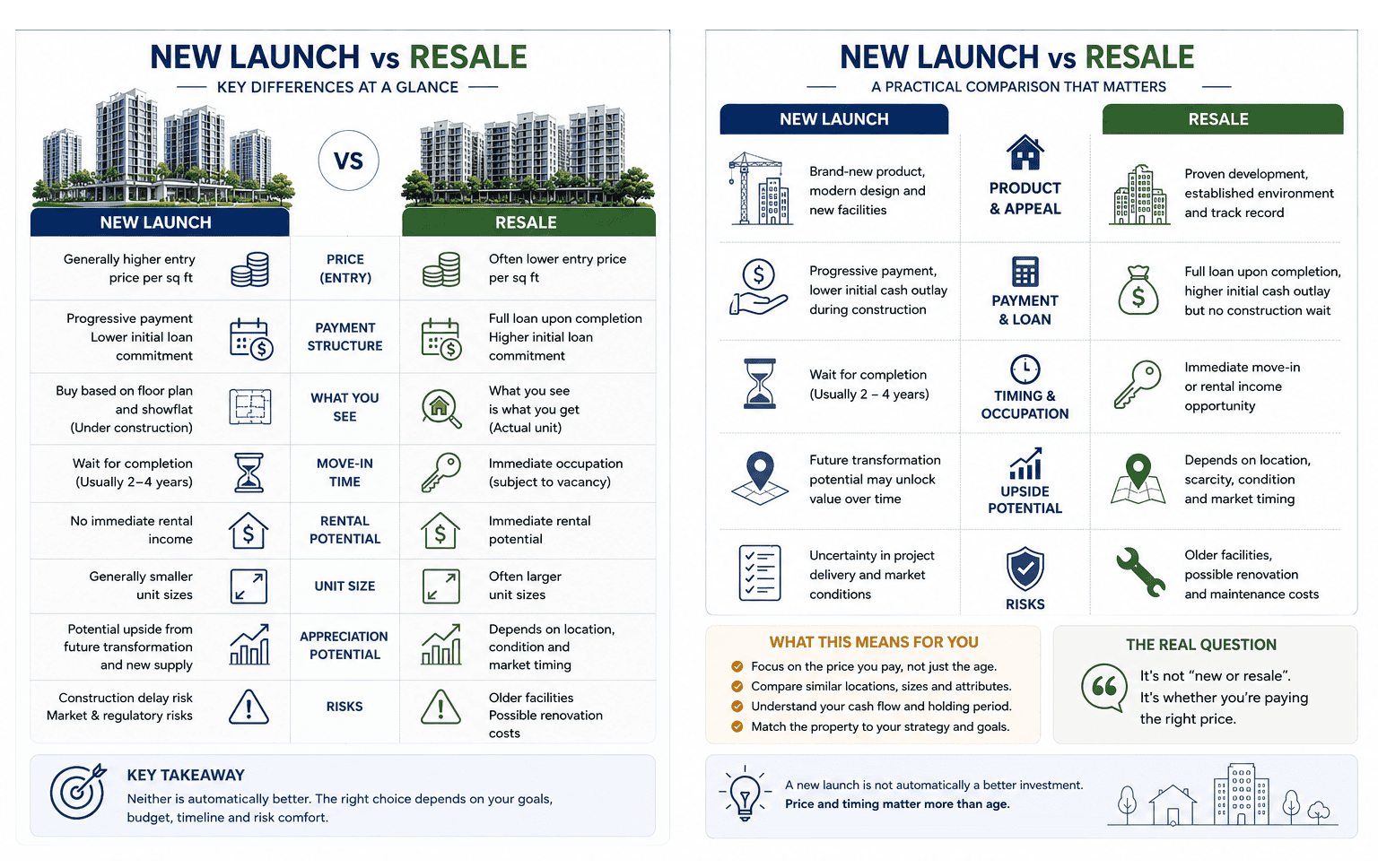
New Launch Vs Resale - Key differences at a glance
New Launch Vs Resale - Key Differences at a Glance

Why Timing Matters

Two buyers in the same development, entering at different phases, end up in different positions: same facilities, same location, different economics. Earlier buyers typically get a lower entry price and more unit choice but more construction uncertainty; later buyers get more certainty but a higher price and fewer good units left. The same applies in resale: buying during a quiet period beats buying when several buyers are competing for the same unit. No one can call the perfect moment consistently, but every buyer should know where their entry price sits relative to the project’s own history and nearby alternatives.

Before You Choose, Assess

  • Entry price relative to comparable alternatives: same location, bedroom type, price range, transport access, and buyer pool, not just new vs old.
  • Total cost of ownership: for new launches, construction-period interest, renovation at completion, full mortgage post-TOP; for resale, immediate full mortgage, renovation, repairs, offset by rental/occupation value.
  • Holding period: shorter periods raise the stakes on entry price, transaction costs (including SSD where applicable), and marketability; longer periods give more room for growth and loan paydown.
  • Future buyer demand: today’s new project becomes tomorrow’s resale project. The unit needs to stand on its fundamentals once the novelty fades.

Ask Yourself

  1. Am I paying a reasonable premium for new, or a sensible price for completed?
  2. Do I need immediate occupation or rental income?
  3. Where does my entry price sit against comparable projects and past transactions?

Key Insight: A new launch isn’t automatically the better investment; price and timing matter more than age. What actually determines the outcome: a defensible entry price, sustainable cash flow, clear future demand, a suitable holding period, and a realistic exit.

Decision 4: How Do You Separate a Good Property From a Good Investment?

Most buyers know quickly when they like a property: the view, the renovation, the lobby, the facilities. That matters, because a property is still a home. But liking it and investing well aren’t the same thing. A beautiful home can still be bought at the wrong price; a popular project can be full of similar units competing for the same buyers. The better question isn’t do I like this property; it’s: what makes this specific unit attractive to future buyers, and how will it compete when I sell?

The Dilemma

Two units, same condo, same bedroom count and facilities:

Unit A: lower floor, faces a busy road, afternoon sun, common layout, several similar units available, slightly lower price.

Unit B: mid-floor, quieter facing, more efficient layout, better privacy, fewer comparable units, slightly higher price.

A buyer focused mainly on price might pick Unit A, but the lower price doesn’t make it better value. Unit B likely appeals to more future buyers because its advantages are harder to replace elsewhere. This is why project-level analysis isn’t enough: a good project can contain weak investment units, and an average project can contain a genuinely strong one. The project matters, but so do the specific unit and entry price.

Where Buyers Go Wrong

  • Paying too much for emotional appeal. A good view or showflat creates urgency, but ask if the premium is reasonable, if the view is protected, and if future buyers will actually value the renovation.
  • Assuming popularity guarantees profit. Strong demand for a project tells you buyers are interested; it doesn’t tell you your specific unit has upside. Two buyers in the same project at different prices get different outcomes.
  • Evaluating the project, not the unit. Developer reputation and branding matter less to resale buyers than layout, facing, view, privacy, floor, and price. A good project doesn’t make every unit a good investment.
  • Ignoring nearby alternatives. A unit can look attractive in isolation but lose to a nearby project with more space, better MRT access, lower maintenance, or a similar price. A strong investment stays competitive beyond its own development.

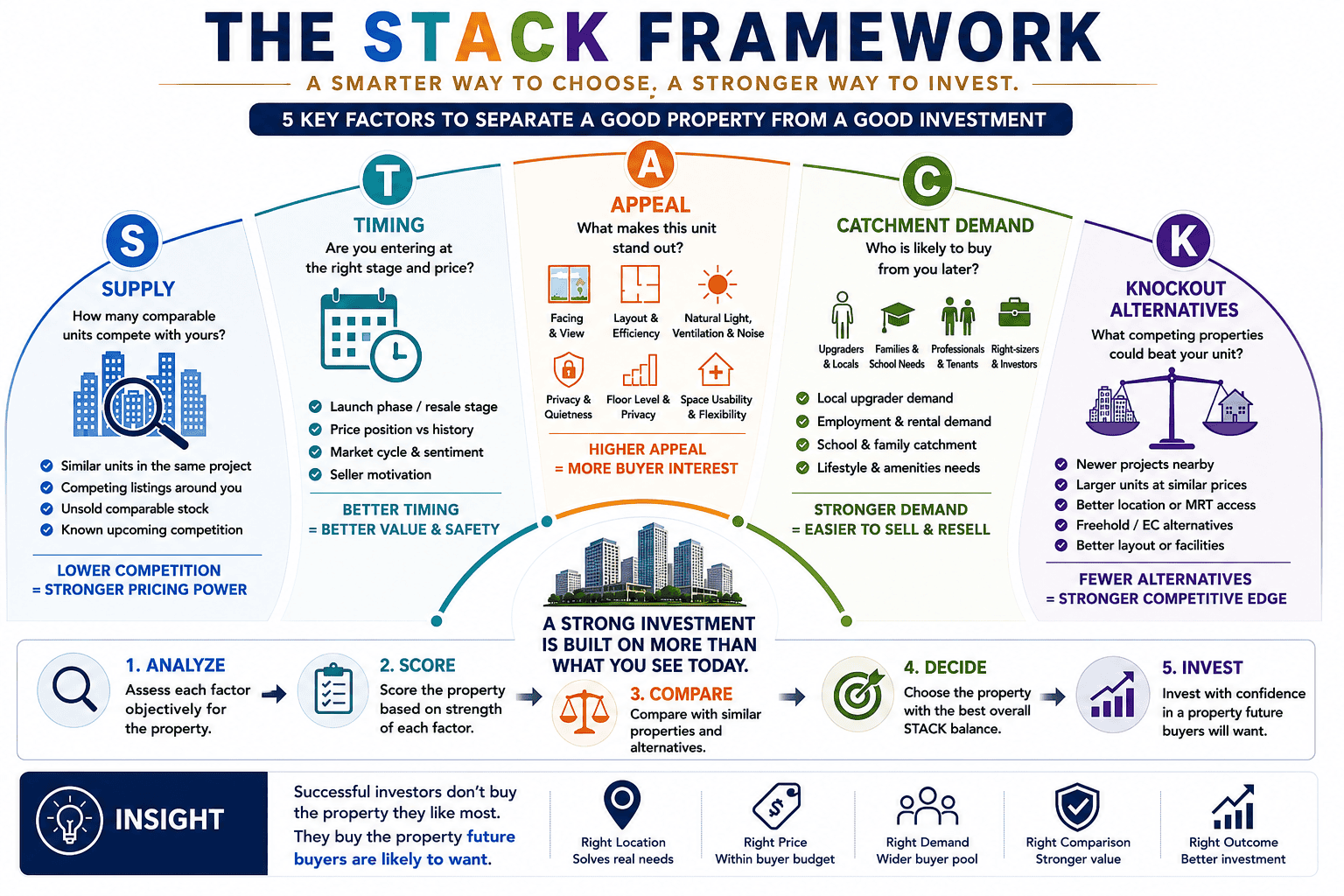
The STACK Framework

A structured way to evaluate a property before buying, focused on what’s knowable at the point of purchase, not on predicting the future:

  • S: Supply. How many close substitutes compete with this unit: same bedroom type, size, layout, facing, floor range and price, within the project and nearby? More substitutes means less pricing power for sellers; genuine scarcity stands out.
  • T: Timing. Where you enter the project’s pricing journey, from early launch through mature resale. Earlier usually means lower price and more risk; later means more certainty and a higher price. The goal isn’t calling the bottom; it’s knowing whether the current price is still defensible.
  • A: Appeal. The unit-level qualities future buyers will keep valuing: efficient layout, good facing, unblocked view, privacy, light, ventilation, sensible balcony size. Buyers pay for usable space, not raw floor area.
  • C: Catchment Demand. Who is realistically buying this from you later: upgraders from nearby estates, families chasing specific schools, professionals working nearby, tenants, right-sizers? A specific, well-reasoned answer beats “the location is good.”
  • K: Knockout Alternatives. What competing properties could make a future buyer choose someone else’s unit instead: a newer nearby development, a bigger unit at the same price, a freehold project at a small premium? Your unit doesn’t need to be perfect, but it needs to hold up against realistic alternatives.
The Stack Framework - 5 Key Factors to Separate A Good Property From a Good Investment

Applying STACK to Unit A vs Unit B

Unit A has more direct competition (Supply) and weaker bargaining power if similar listings are already on the market (Timing). Unit B offers better privacy and layout (Appeal) that matters to family buyers (Catchment), and holds up better against nearby alternatives with stronger facings (Knockout). The slightly pricier unit ends up in the stronger long-term position, proof that the lowest-priced unit isn’t always the best-value unit.

Ask Yourself

  1. How many realistic substitutes could a future buyer choose instead?
  2. What specific qualities justify the price I’m paying?
  3. Who is the natural future buyer, and why would they choose this?

Key Insight: Successful investors don’t just buy the property they like most; they buy the property future buyers are likely to want.

Decision 5: What Is the Real Cost of Waiting?

Buyers often assume waiting is the safest choice: for prices to fall, rates to improve, more savings, more certainty. Sometimes that’s right. But doing nothing is still a decision, and it carries its own risk: the target property gets pricier, the downpayment needed grows, the gap to your next home widens, borrowing flexibility weakens. The real question isn’t whether to wait; it’s: is waiting genuinely improving your position?

The Dilemma

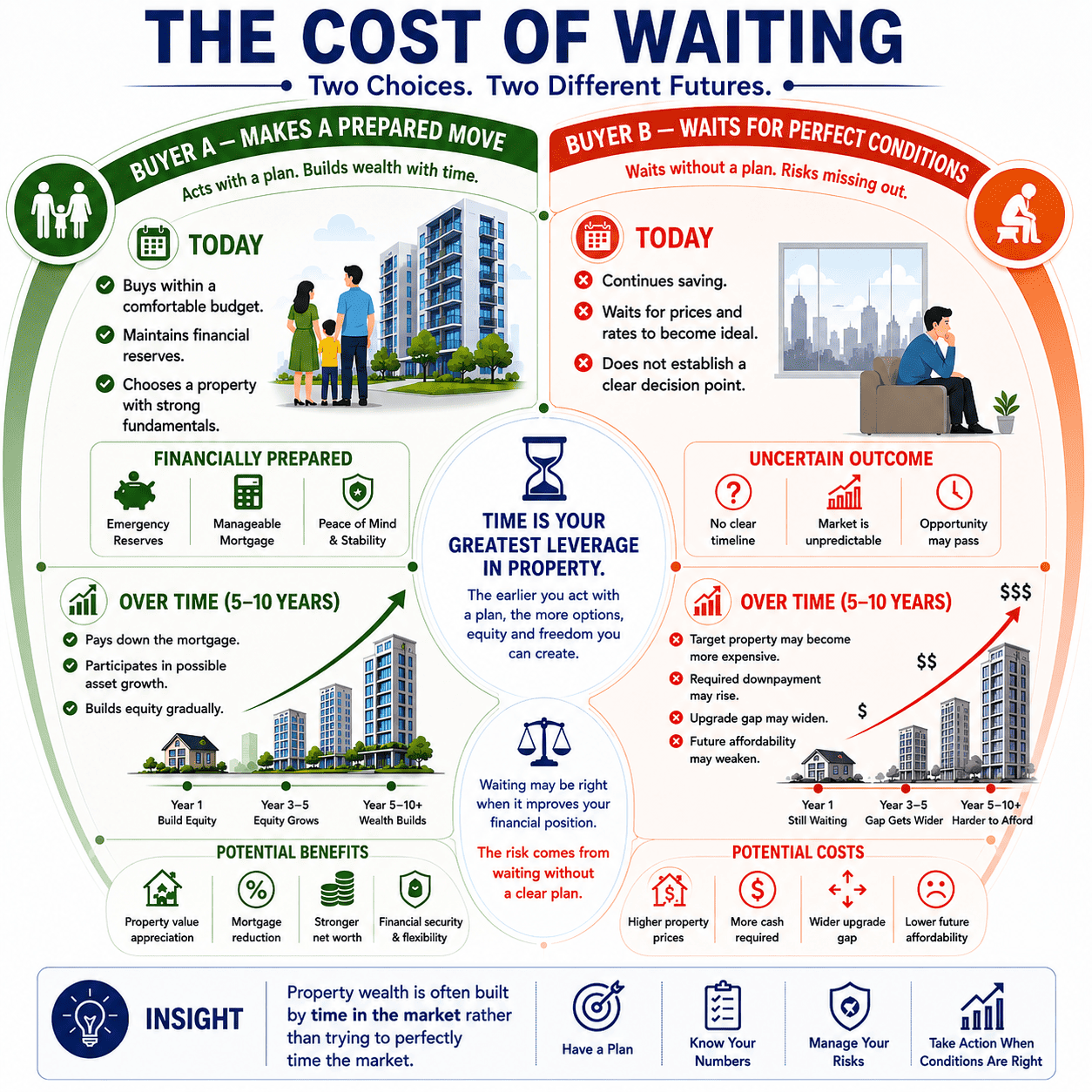
Buyer A buys within a comfortable budget, keeps reserves, picks a property with reasonable fundamentals, and accepts markets are never perfect. Over time they pay down the mortgage, participate in possible growth, and keep future options open.

Buyer B keeps saving, waits for ideal prices and rates, never sets a clear decision point, and keeps delaying whenever uncertainty remains. Over time, the target property may get pricier, the downpayment needed may rise, and the upgrade gap may widen.

This doesn’t guarantee Buyer A wins; prices can stagnate or fall. The difference is Buyer A acts with a plan; Buyer B waits without one.

Where Buyers Go Wrong

  • Waiting for a price drop with no trigger point. No clear view of how large a decline, what evidence supports it, or what price would actually trigger action. Someone uncertain in a rising market often feels even more fearful in a falling one; waiting for a correction is still a market decision.
  • Assuming lower rates automatically mean a cheaper purchase. Lower rates can boost buyer confidence and borrowing capacity too; if demand strengthens, prices can rise to offset the cheaper financing.
  • Saving without a defined target. “More savings” without a measurable number (reserves, renovation budget, max mortgage, downpayment) can become an indefinite excuse to postpone.
  • Waiting for certainty. Assurance that prices won’t fall, rates will improve, and demand will stay strong rarely exists, and by the time the market feels fully safe, prices usually already reflect that confidence.

The Hidden Cost of Delay

  • A higher future price: larger downpayment, more CPF/cash, bigger mortgage, higher stamp duty, and possibly a shorter loan tenure pushing up monthly repayments. Savings built up while waiting can simply get absorbed by the higher entry price.
  • Lost time for equity building: through loan paydown, potential appreciation, and rental income, where applicable. Sitting outside the market means missing that window entirely.
  • A widening upgrade gap. Example: current HDB worth $700,000, target condo $1,500,000, an $800,000 gap. If the HDB rises 5% and the condo rises 10%, the HDB becomes $735,000 and the condo $1,650,000, and the gap widens to $915,000, even though both properties gained value.
  • Reduced future affordability: shorter loan tenure, higher instalments, and less borrowing flexibility as time passes.

When Waiting Actually Makes Sense

  • Income is unstable: uncertain employment, a career change, heavy commission-based income, or a mortgage that only works with two incomes.
  • Reserves are insufficient: for emergencies, renovation, repairs, and temporary income disruption. Using nearly every available dollar to buy creates unnecessary risk.
  • The property offers poor value: excessive price, weak appeal, heavy competing supply, unclear buyer catchment, or a poor STACK result. Buying fast doesn’t compensate for buying badly.
  • The holding period is too short: transaction and ownership costs are substantial; if you may need to sell within a short window, waiting is often the safer call.

Passive Waiting vs Active Preparation

Passive waiting: no target, no deadline, no shortlist, no measurable trigger, constantly shifting reasons to delay.

Active preparation: a defined reserve, a comfortable mortgage limit, a target price range, a shortlist, planned market check-ins, and action once agreed conditions are met. This turns delay into a strategy rather than an excuse.

The Cost of Waiting - Two Choices & Two Different Futures

Before You Decide to Wait, Ask

  1. What exactly am I waiting for?
  2. What measurable condition will trigger action?
  3. Is the delay strengthening my position, or just postponing the decision?

Key Insight: Property wealth is usually built through time in the market, not by timing the market perfectly. The better question isn’t “is this the perfect time”; it’s “am I prepared, is this the right property, and can I hold it long enough for the strategy to work?”

Conclusion: Your Next Property Move Starts With Better Decisions

Staying put, upgrading to an EC, moving into private property, buying new or resale, or waiting: these can look like separate questions, but each decision affects the next. The property you choose today shapes your mortgage, cash reserves, family flexibility, future buyer pool, and eventual exit. A successful property journey isn’t built on one perfect purchase; it’s built through a series of better decisions.

  • Decision 1: What role should the property play? Housing stability, lifestyle, wealth progression, or a balance: meet genuine family needs without ignoring long-term marketability.
  • Decision 2: How far can you move comfortably? The right upgrade isn’t always the biggest one; it’s the one you can sustain while keeping future options open.
  • Decision 3: New or resale? Neither is automatically better; price, timing, cash flow, holding period, and demand decide it.
  • Decision 4: Does the property pass STACK? Supply, Timing, Appeal, Catchment Demand, Knockout Alternatives. A strong project isn’t enough; the specific unit and entry price matter.
  • Decision 5: Is waiting improving your position? Sensible when it strengthens finances or avoids a bad purchase; risky when it has no clear target.

There Is No Universal Best Property

Every household starts from a different position: income, CPF, equity, age, family needs, and risk tolerance all shape what’s suitable. That’s why the question shouldn’t start with “which project should I buy,” but with “what am I trying to achieve, and what position do I want to be in after the purchase?”

Better Decisions Create Better Options

A well-planned move can give you the flexibility to hold through weak markets, avoid becoming a forced seller, upgrade when the right opportunity appears, right-size later, and preserve cash for other priorities. Property wealth isn’t measured only by asset value; it’s also reflected in the choices and flexibility that asset creates.

Final Takeaway

The property that creates the most wealth is rarely the most expensive one. More often, it’s the one that aligns with your goals, financial capacity, family needs, holding period, and future buyer demand.

Your next property move doesn’t begin with a showflat visit. It begins with better questions, and better questions lead to better decisions.

Need Real Estate Consultation?

Contact Me

Feel free to connect with me!

DARREN ONG 93839588 Huttons Asia Pte Ltd

Group District Director
Huttons Asia Pte Ltd
CEA Registration No.: R026434F
Agency License: L3008899K
Contact: 93839588

Please follow and like us if you like my articles:
error: Content is protected !!

Get Your PrimeKey Analysis Report

Share what you’re considering. I’ll reply with a data-backed view and what to watch out for.

By submitting, you agree to be contacted for this request. Your details won’t be shared.

Register Your Interest